Auburn Bay sits on Calgary's southeast edge, boxed in by Stoney Trail to the north, Deerfoot Trail to the west, 52 Street SE to the east and Seton Boulevard to the south. Building started in 2005, and by the 2021 municipal census the community had 18,090 residents in 6,245 homes. At its centre is a 43-acre private lake where residents paddle, fish and swim in summer and skate in winter. That lake shapes what fills an Auburn Bay garage: kayaks, paddleboards, life jackets, beach chairs and skates, on top of the hockey bags, bikes, winter tires and snow shovels every Calgary family already owns. We sort it, give each season a zone, and get the car back inside before the cold sets in.
The residents' association does not allow boats to be stored overnight at the lake accessways, and paddleboards can't be left there unattended. Your kayak sleeps in the garage.
Paddling and beach gear from late spring to fall, then skates and sticks once the lake ice is maintained. The swap happens twice a year, so it needs a plan.
Auburn Bay School, Prince of Peace, St. Gianna, Bayside and Lakeshore all sit in the community. That means scooters, bikes, backpacks and sports bags by the door every weekday.
Front-attached doubles, rear detached garages off the lane, townhome singles and lots that still only have a parking pad. Each one needs a different layout.
Most detached homes built by Morrison Homes, Jayman BUILT, Albi Homes and the other builders here came with an attached double garage at the front. These are the garages where two cars were supposed to fit and one usually does. The fix is almost always the same: clear the floor down the full length of the second bay, move bins onto steel shelving or overhead racks, and put a landing zone for school bags, boots and sports gear beside the door into the house so it stops spreading across the slab.
Many Auburn Bay streets have back lanes, and the homes on them park in a detached garage at the rear of the lot. A detached garage is unheated, a longer walk from the kitchen and an easy place to let things pile up because nobody sees it from the house. We keep anything that hates the cold (paint, batteries, the kids' craft bins) out of it, put the lake gear and yard tools on the walls, and leave a clear path from the man door to the car.
Some lane homes were sold with a rear parking pad instead of a garage. One 2010 Auburn Bay house we read about was listed with a four-stall pad and no garage at all. If that is your situation, the storage plan moves to a shed, the basement and a deck box, and when you do build, we can lay out the new garage before the walls go up so the outlets, racks and bike hooks land where you need them.
On the newer, bigger lots the garage can be much larger. A 2015 home in Auburn Meadows, for example, was listed with an oversized triple detached garage, a carriage suite with its own attached single garage and parking pads, and a dedicated RV space. Garages like that need each bay assigned a job (daily cars, the trailer and boat gear, a workshop) and the suite's storage kept separate so tenants or family have their own shelves.
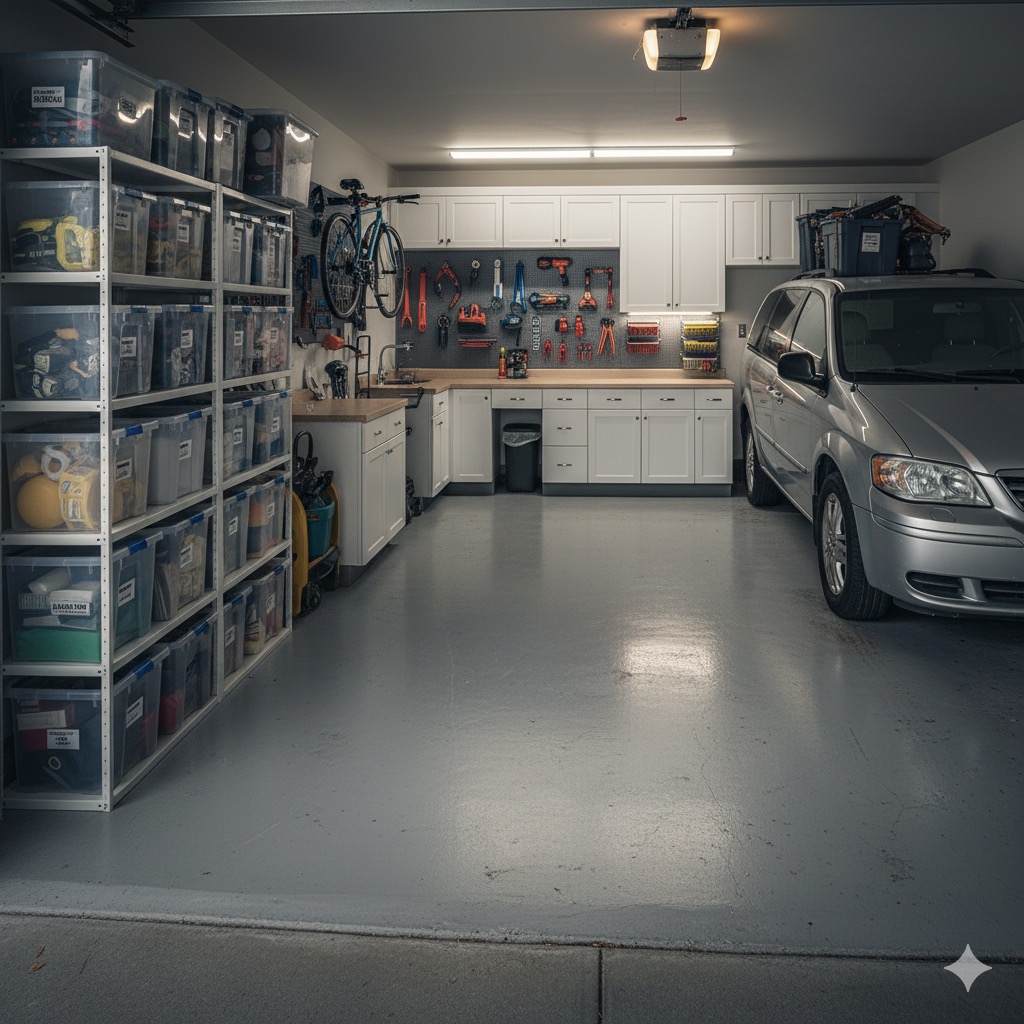
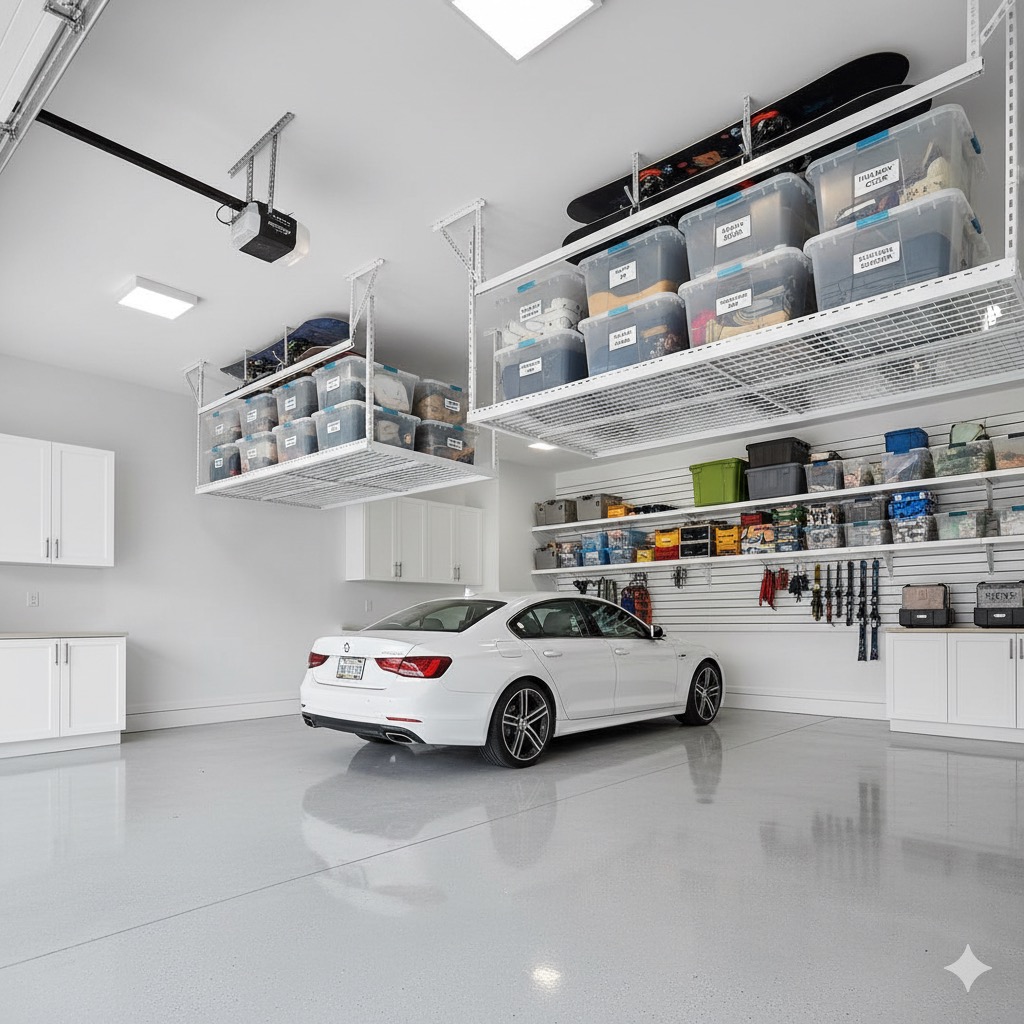
One wall of shelving gives back a parking spotThese images illustrate the layout we build in a typical front-attached double; they are not photos of an Auburn Bay home. Boxes go into labelled bins on one shelving run, the bike goes on the wall, and the floor stays clear enough to open both car doors.
The Auburn Bay Residents Association's accessway rules say boats are not to be stored at the dock or on the accessway for extended periods and that no overnight storage is allowed. Personal belongings such as chairs, mats and SUPs can't be left unattended there either. Lake Auburn is non-motorized, so private kayaks, canoes, paddleboards and small sailboats are what residents own, and every one of them comes back up the path to a garage at the end of the day. A 12-foot kayak and two inflatable boards lying on the floor take the space of a small car.
Kayaks and canoes go on padded wall cradles along the side wall or on a ceiling hoist above the hood of the car. Before we hang anything overhead, we measure the garage door's travel and the opener rail so the boat clears both. Hard paddleboards store best on edge in a vertical rack with the fin removed; inflatables are rolled dry and kept in their bags on a shelf. Paddles hang in a row on a rail, and life jackets go on open hooks where they can dry instead of mildewing in a bin.
The association's boating rules require any personal watercraft used in other waters to be cleaned before it launches on the lake, which lines up with Alberta's Clean, Drain, Dry message for stopping aquatic invasive species. If your family paddles at Ghost Lake or in Kananaskis in the summer, give the boat a place to drain and dry near the overhead door: a mat, a hose bib nearby if you have one, and a hook for the sponge and drain plug. Wet hulls that go straight onto a ceiling hoist drip on the car for a day.
Residents can fish from the docks and boats with a membership card on file at Auburn House, so many garages also hold rods and a tackle box. Rods go on a vertical wall rack, tackle on one shelf. Beach chairs, umbrellas, sand toys and the cooler share one bin zone by the overhead door from May to September. In late fall that zone flips: beach gear moves to the overhead rack, and skates, helmets, hockey sticks and a small net come down to the same spot so the kids can grab them on the way to the lake.
Off-season gear goes upAn illustration of the overhead racks we use for whichever lake season is out of rotation. Bins are labelled by season so the spring and fall swap takes an hour, not a weekend.
In an attached garage, the three feet beside the door into the house decide whether the rest stays tidy. We put a boot tray on the floor, a bench or shelf for backpacks, hooks at kid height for helmets and jackets, and one bin per child for the things that never make it inside. In a lane garage the same zone goes by the man door.
A zipped hockey bag left on the floor overnight smells by morning. An open wire rack or a set of hooks lets pads and gloves dry between practices, and it keeps the bag off a slab that is wet with melted snow from November to March.
Auburn Bay's pathways around the lake and the parks make bikes and scooters daily equipment for most families here. Adult bikes go on vertical wall hooks, kids' bikes and scooters in a low floor rack so children can put them away themselves, and the stroller and wagon fold into a marked spot that never blocks the car door.
Auburn Bay is bordered by two of the city's busiest freeways, and most commutes start on one of them. Cars come home coated in road salt and gravel, and the slush in the wheel wells melts across the floor. Anything stored in cardboard on the slab soaks it up. Shelving on legs, wall rails and overhead racks keep stored items above the wet, and a sealed floor lets you squeegee the brine to the door. Our garage floor cleaning service can strip a winter of salt residue before a new system goes in.
A chinook can push the afternoon above zero and drop it well below overnight. Water in a detached lane garage refreezes into a sheet across the slab, and tools stored low start to rust. We keep metal tools on the wall, lift the snowblower onto a drip mat near the door and leave the drain path clear.
Two vehicles means eight tires that come off twice a year. A wall-mounted tire rack in the back corner holds both sets vertically and off the floor, with the lug wrench and torque settings on a tag beside it. If you would rather the dealer stored them, that corner becomes room for the snowblower.
Calgary's summer hailstorms are the strongest argument for keeping both bays clear all year, not only in winter. The households that make it through June to September without dents are the ones who can pull the car in on ten minutes' notice when a storm warning comes up on their phone.
Nothing on the floor that can soak up slushAn illustration of a winter-ready garage: closed cabinets on the back wall, bins on shelving and a coated slab that dries quickly after the car comes in wet.
The City of Calgary's updated recreational vehicle rules took effect on April 1, 2025. From April 1 to October 31 an RV can sit on a front driveway for up to three consecutive days before it has to move away for 48 hours. From November 1 to March 31, front-driveway RV parking is not allowed at all, and detached trailers and campers can't be parked on streets or in lanes. For an Auburn Bay family with a utility trailer, a tent trailer or a boat on a trailer, that means a planned spot at the back of the lot, a storage yard, or a bay in the garage.
A compact utility trailer or a kayak trailer can tip up on end against the back wall of a deep garage, or slide into the third bay of a triple. We plan the shelving around it and keep the camping bins that travel with it on the shelf directly above, so packing for a trip is one stop.
Text us a few photos of the garage or book a walkthrough. We note whether it is attached or a lane garage, the ceiling height and door opener, the boats and boards you own and how many cars need to fit.
Every item goes into keep, sell, donate, recycle or dispose. Outgrown skates, punctured floaties and the broken scooter leave with us, along with donations and household hazardous waste.
Parking, the landing zone, the lake gear wall, the swap zone, the tire corner and long-term storage, each with shelving, wall rails, overhead racks or custom garage storage chosen to fit.
Racks and hooks go into studs or ceiling joists, overhead storage is checked against the door's travel, and every bin is labelled by contents and season.
Before we leave, we show you which bins come down in May and which go up in October, so the system still works the first time the lake freezes.
From the lakefront homes to the lane streets near Auburn Station and the newer phases by Seton
Shelving, wall systems, overhead racks and cabinets, and how to choose between them.
A deep clean of walls, floor and shelving after the sort, or before you list the house.
The lake community across Stoney Trail, with the same paddle-and-skate gear questions.
A full clear-out first, when the garage has to be emptied before anything can be organized.
Yes. Auburn Bay is on our southeast Calgary routes along with Mahogany, Cranston, McKenzie Towne and Seton. Quotes are free, and a few photos sent by text are usually enough to start.
Garage organization starts at $199 for a standard garage. A full clear-out with removal, a triple garage or custom cabinetry costs more depending on size and finish. We give a free, fixed written quote before any work begins.
The residents' association does not allow overnight boat storage at the accessways, so they go in the garage. We use padded wall cradles or a ceiling hoist for kayaks and canoes, a vertical rack for hard boards, a shelf for rolled inflatables and open hooks so life jackets dry.
Usually, yes. We measure the overhead door's travel and the opener rail first, then position the hoist so the boat clears both when the door is open and the car is parked.
Yes. Lane garages are unheated and out of sight, so they fill fastest. We keep cold-sensitive items like paint and batteries out, put lake gear and yard tools on the walls, and keep a clear path from the man door to the car.
We set up one swap zone by the overhead door and label overhead bins by season. Beach and paddling gear is in reach from May to September, then skates, sticks and helmets take its place for winter.
Most single or double garages take 4 to 8 hours in one visit. A triple garage, a full clear-out with haul-away or a custom cabinet install can need a second visit. We confirm the schedule in your free consultation.
Get your free consultation today. We will put the kayaks and boards on the wall, set up the summer and winter swap, give the tires a rack and clear the second bay so both cars are inside before the next storm.
Call or text: photo quotes are perfect for busy Auburn Bay families!
Auburn Bay, SE Calgary
Plus Mahogany, Cranston & SetonThe fastest way: call or text a photo of your garage and we'll have a quote back to you the same day.
Call (587) 804-9266 Text Us a PhotoMon–Fri 8am–6pm · Sat 9am–4pm · texts answered evenings too