Every generic organizing guide was written for a climate that isn't yours. Calgary garages
hold four sets of winter tires, hockey bags, and a car that genuinely must be inside
by June — in a room that swings from −30 to +30 across the year. We design and
install systems around how this city actually lives: tire walls, hail-season layouts, and
hardware that doesn't shatter, sag or fall off in a cold snap.
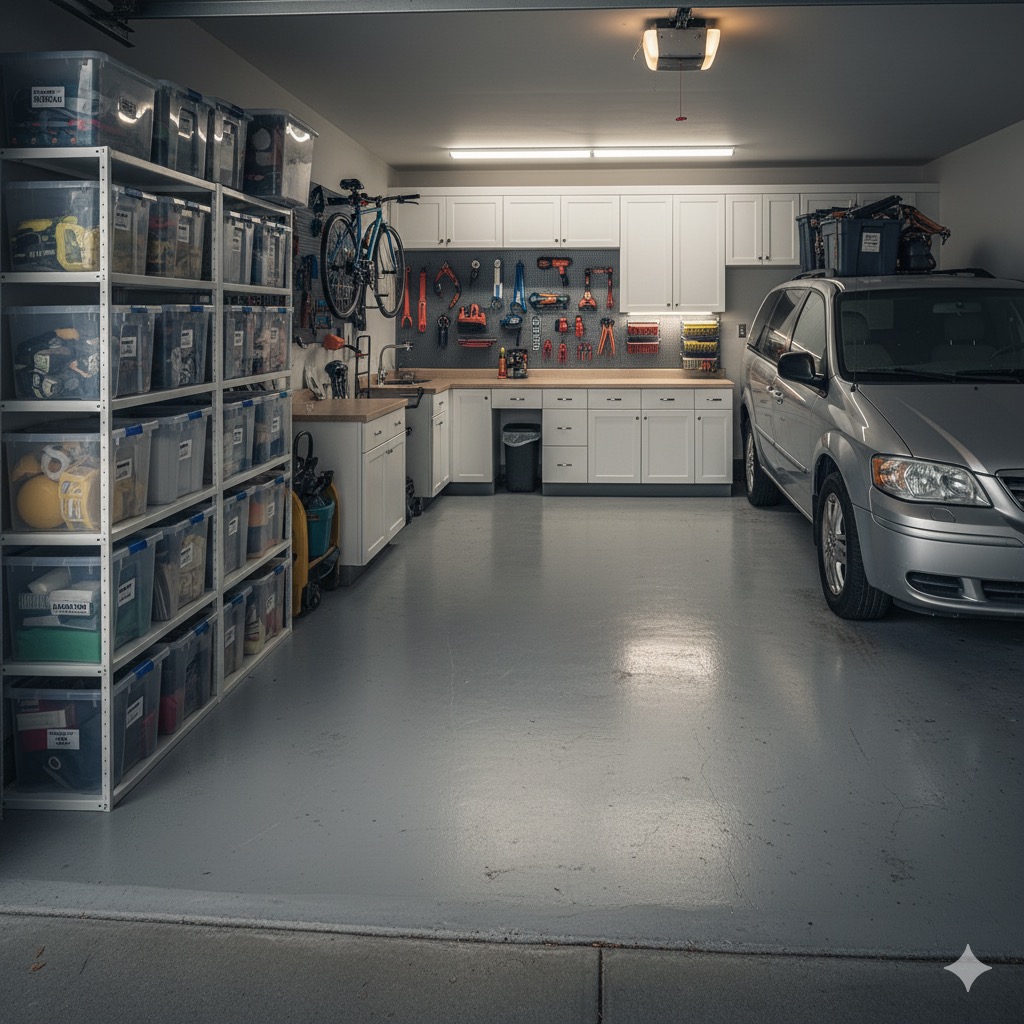
One day. Both bays back.Wall rail, steel shelving, overhead rack, labelled bins — and a car-shaped space defended before hail season, not after.
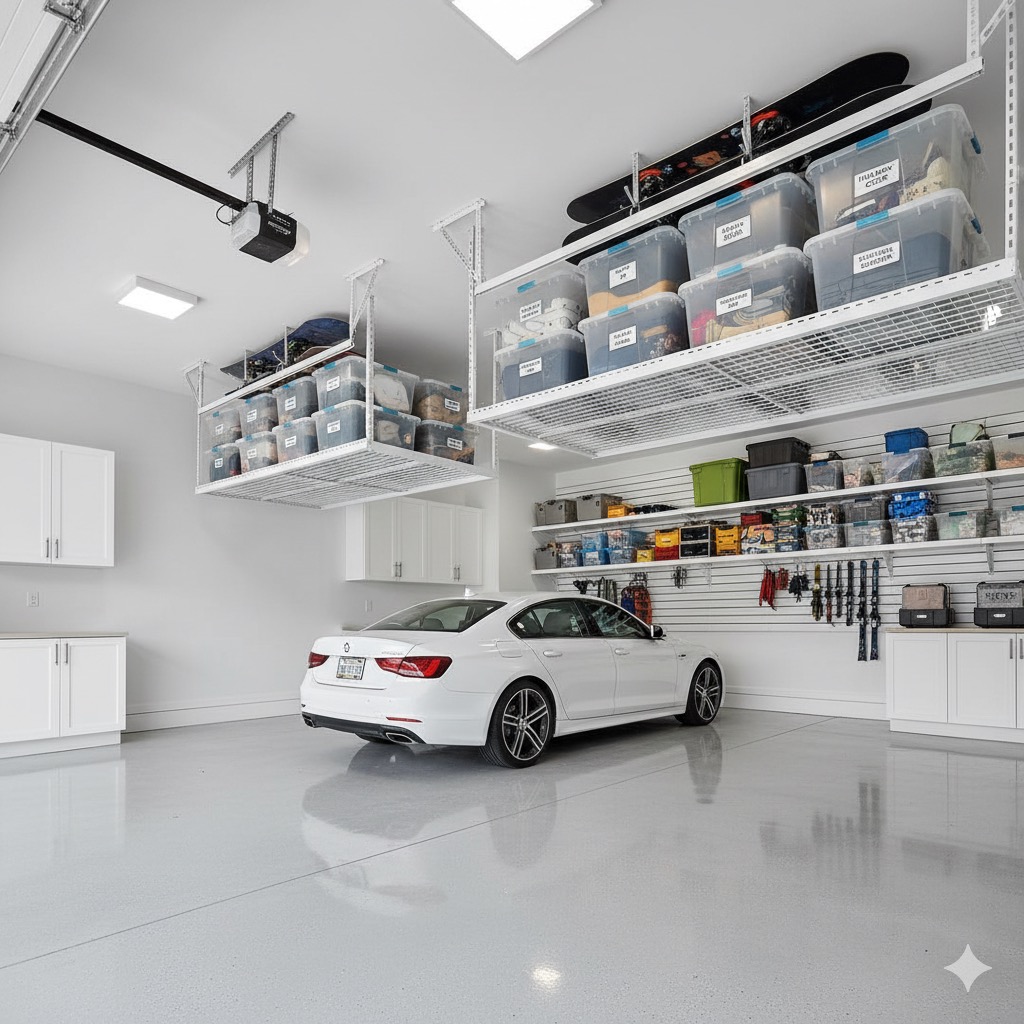
Overhead is where the winter gear goesCeiling racks above the hood line take the twice-a-year items — decorations, luggage, off-season sport — off the slab entirely. In a Calgary garage that is usually the difference between parking inside and parking outside from November to April.
4–8Winter tires needing a home in a typical Calgary household
June–SeptHail season — when the parking bay earns its keep
60°CAnnual temperature swing your storage has to survive
from $199Basic Sort package — fixed written quotes
Why Calgary Garages Get Disorganized
It isn't laziness, and it isn't lack of shelving. Calgary garages fail for a structural
reason: this city runs on seasonal churn, and most garages have no system for it.
Twice a year, every Calgary household turns its gear over. Winter tires on, summer tires
stored. Hockey season ends, bike season starts. Skis up, camping down. Christmas bins out,
patio cushions in. Each swap moves fifteen or twenty bulky items — and when those items have
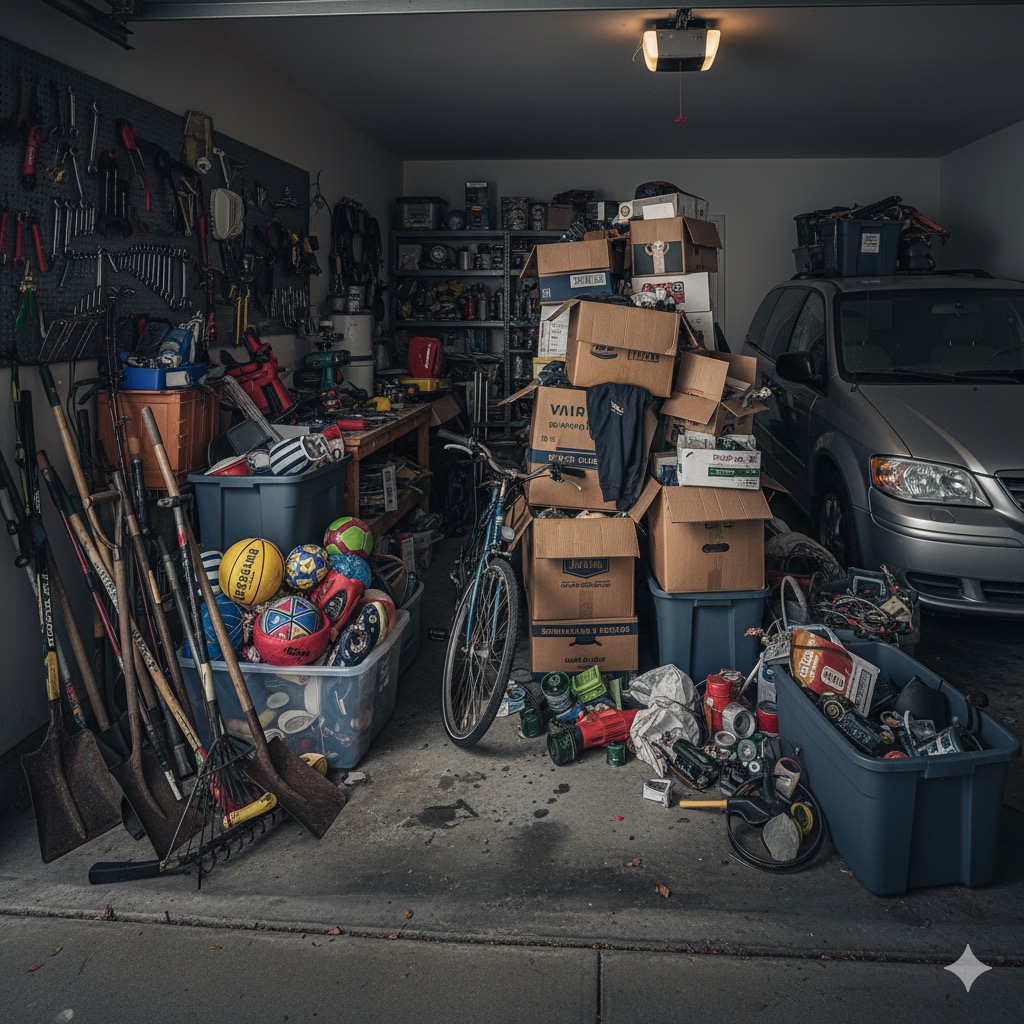
no fixed home, each swap deposits a new sediment layer on the garage floor. Two or three
years of that and the car is on the driveway, which in this city is not a cosmetic problem.
So the job here isn't "tidying." It's building a system where the seasonal swap takes an hour
instead of a weekend, where the off-season set has a labelled destination before the
in-season set comes down, and where the parking bay is structurally protected from becoming
the overflow zone. That's what we design and install.
The Calgary Rulebook — Where Coastal Advice Is Wrong
Most garage organization content online is written for damp climates, and in Calgary a lot of
it is actively backwards. We also work in Metro Vancouver, so we know both rulebooks — and
they genuinely differ. What changes when the air is dry and the winters are real:
Standard organizing advice versus what actually works in a Calgary garage.
Topic
The generic advice
The Calgary reality
Clear vs. opaque bins
Gasketed opaque bins to fight humidity
Clear bins are fine and better — dry air means visibility wins. Spend the money on cold-rated plastic instead.
Open shelving
Risky — everything mildews
Works well here. The enemy is chinook dust, not mould — lids for fabrics, open shelves for everything else.
Cheap plastic bins
Fine everywhere
Bargain polypropylene goes brittle below about −20 and shatters when bumped. Cold-rated totes only in unheated garages.
Adhesive hooks & strips
Renter-friendly and easy
The bond stiffens and pops in a cold snap — usually under your ladder. Mechanical fixing into studs, always.
Floor storage near the car
Acceptable if tidy
The bottom 45 cm around the parking bay is a salt-splash zone all winter. Metal stored there corrodes; keep it clear or plastic-only.
Paper, books, fabric
Never in a garage
Genuinely workable here in lidded bins — dryness protects them. Photos, vinyl and electronics still go indoors: the −30 to +30 cycle wrecks adhesives and batteries.
Aerosols & liquids
Any shelf will do
Paint, caulk, glue and pop cans freeze, separate or burst. One labelled "freeze-safe" bin comes indoors each November — we build it into the layout.
When to organize
Spring cleaning season
Any month — Calgary garages are mostly attached, and a January install means you're ready before the spring rush, not queued behind it.
The one Calgary-specific failure we see most
A beautiful system installed in July that dies its first winter: adhesive hooks on the
wall, bargain bins on the floor, metal tools stored in the splash zone, and the paint
shelf left to freeze. By March the hooks are on the floor, two bins are cracked, the
pliers are rusty and the paint is ruined. Every one of those is a materials decision,
not a discipline problem — and every one is avoidable at spec time for a few dollars.
The Winter Tire Wall
No object defines Calgary garage storage like the winter tire. Nearly every vehicle in this
city runs two sets, which means a two-car household is storing eight tires —
roughly a cubic metre and 80–100 kg of rubber — for six months at a
stretch, usually as a leaning stack exactly where a car should be.
The rules we install to:
On rims: hang on wall hooks or stack flat, up to four high. Hanging is kindest to the tire and takes zero floor space.
Off rims: stand upright on the tread, and give them a quarter turn monthly — stored wrong, tires flat-spot and you feel it at highway speed in November.
Placement: out of direct sun and away from the electrical panel, battery chargers and any motor — ozone and UV age rubber faster than time does.
The arithmetic: a wall-mounted tire rack holds a full set in about 120×120 cm of wall. Tire hotels in Calgary charge per set per season; the rack costs roughly one season's fees and works for a decade.
In our layouts the tire wall goes beside the garage door on the driver's side where wall
space is usually dead anyway — swap day becomes carry, hang, done.
Designing Outward From the Parking Bay
Here's the design principle that separates a Calgary layout from a generic one:
the car's space is allocated first, and everything else fits around it.
Not the other way around.
The reason is on every Calgary insurance statement. This is hailstorm country — the June 2020
storm alone did over a billion dollars of damage, much of it to vehicles parked outside — and
hail season runs June through September. A garage too full to park in isn't untidy here;
it's an uninsured exposure with a deductible attached. The single most valuable thing your
garage can do is hold your car on a July afternoon when the sky goes green.
Practically, that means we mark the parking footprint plus door-swing clearance on day one
and treat it as untouchable. Storage goes up the walls and overhead, the seasonal churn gets
routed around the bay, and the layout fails gracefully — if the system ever slips, it slips
into a corner, not into the space your car needs at 4pm before a storm.
The Seven-Zone Calgary Layout
Our standard Calgary zone allocation, adapted to each garage's contents.
Zone
Typical contents
Where and why
1. Parking bay
The car, June through September especially
Allocated first, marked, defended — hail season is the reason the garage exists
2. Tire wall
Winter/summer sets for every vehicle
Wall racks by the door, dead-wall space, one-hour swap days
3. Seasonal swap
Skis, hockey bags, camping, Christmas bins
Overhead racks and top shelves — the off-season set always has a labelled destination
4. Daily access
Recycling, shoes, dog gear, current-season sports bag
Nearest the house door at waist height
5. Workshop
Tools, fasteners, workbench
One wall, pegboard over bench, out of the salt splash zone
6. Garden & yard
Mower, shovels, soil, hoses
Nearest the overhead door; snow tools swap to front position in October
7. Freeze-safe
Paint, caulk, aerosols, anything liquid
One labelled bin that migrates indoors each November — built into the plan, not remembered in February
Hockey Bags, Skis, Bikes and the Rest
Calgary gear has Calgary problems, and each one has a specific fix:
Hockey bags — the defining smell of a Calgary garage in winter. The fix
is airflow, not air freshener: an open ventilated rack near the door, gear spread to dry
after every skate, never a zipped bag on the floor. We build a hockey station in
rink-family garages as standard.
Skis and snowboards — vertical wall racks in season. The dry air is
actually good to them; just keep edges wiped after slushy chinook days, because melt
brine rusts steel edges fast.
Bikes — wall-hung always, and doubly so November through March when the
floor is a salt lagoon that eats drivetrains. Vertical hooks for the daily riders,
ceiling hoists for the fat bike and the kids' spares.
Camping gear — bins grouped by trip type, stored high. Calgary bonus:
dry air means tents and bags store safely for years — but never pack them away damp from
a September Kananaskis weekend, because the one thing that does mould here is the thing
you sealed wet.
Golf clubs — fine in the garage, high and dry; regrip season is
February anyway.
The outgrown pipeline — kids' skates, bikes and sticks turn over every
two seasons. We build a labelled "outgrown" bin into every family layout with one job:
when it fills, it goes to donation. Without that outbound route, a Calgary garage becomes
a museum of size-3 skates.
How the Service Works
1
Assessment and measure
Walls, ceiling height, door tracks, panel location, stud spacing, what you own and what season it moves in. We mark the parking footprint first and design outward from it.
2
Sort before anything is installed
Keep, donate, dispose — building storage for things you don't want is the fastest way to waste the budget. If the garage needs a full cleanout or decluttering day first, we fold it in.
3
Fixed written quote
Package, hardware list and a fixed price confirmed before work starts. No surprises after — the number you approve is the number you pay.
4
Install to Calgary spec
Wall rail and shelving fixed mechanically into studs, cold-rated bins, tire racks hung, overhead racks loaded with the off-season set, freeze-safe bin labelled and staged. Winter installs are routine.
5
Label, map and hand over
Every zone labelled plus a one-page map of what lives where — so the system survives contact with the rest of the household, which is the real test.
Garage Organization Packages — Calgary
Fixed written quotes confirmed after assessment. GST additional. Full package detail on our service & pricing page.
How much do garage organization services cost in Calgary?
Basic Sort from $199 (reorganise existing storage). Full Organization from $399 single-car / $650 double-car, including wall rail and up to four shelving units. Premium with Shelving from $799 double-car, materials included. Every price is a fixed written quote after assessment; GST additional.
What makes a Calgary garage different to organize?
The climate flips the coastal rulebook. Dry air means clear bins and open shelving genuinely work here — mould barely matters. What matters instead: cold that shatters cheap bins and pops adhesive hooks, a winter salt splash zone by the car, chinook dust, tire sets in every household, and a hail season that makes indoor parking the garage's most valuable job.
How should winter tires be stored?
On rims: hung on wall hooks or stacked flat up to four high. Off rims: upright on the tread, quarter-turned monthly to prevent flat-spotting. Out of sun, away from the panel and motors. A wall rack holds a full set in about 120×120 cm and costs roughly one season of tire-hotel fees.
Why design around the parking bay?
Hail season. June to September, a car on the driveway is a claim waiting to happen — June 2020 made that arithmetic vivid for the whole city. We allocate the car's space first, mark it, and fit everything else around it so the system can never slip into the bay.
Do adhesive hooks and cheap bins really fail here?
Reliably. Adhesive bonds stiffen and pop in unheated garages during cold snaps, and bargain polypropylene goes brittle below about −20 and cracks when bumped. We fix mechanically into studs and spec cold-rated totes — slightly more once, nothing after.
How long does it take?
Basic Sort: about a half day. Full Organization on a double: a full day including installation. Premium with custom shelving: one to two days. Winter installs are routine — most Calgary garages are attached and we work year-round.