A parent's garage is usually the last room anyone wants to start and the one that holds the most. Forty years of a house end up there: the workbench, the second fridge, the paint from every room ever painted, the boxes moved in from a previous home and never opened. It is also where the risky things live, like an old rifle in the rafters, a row of propane cylinders, or a garden pesticide older than the grandchildren.
This page covers how an estate garage cleanout in Calgary works with us, in the order the decisions come up. If you'd rather talk it through, call (587) 804-9266 and we'll start with your dates.
What's in a Parent's Garage, and Who Decides
In Alberta the person named in the will to settle the estate is the personal representative (the executor). Legally, the garage contents are estate property and that person decides what happens to them. In practice we take direction from one named contact, agreed on the first call, so a sibling who drops by on day two can't send the table saw to a friend's truck while the rest of the family assumes it's being sold.
Here is what turns up in nearly every estate garage, and what we do with each category:
| What we find | Why it needs care | What happens to it |
|---|---|---|
| Firearms, ammunition | Legal transfer rules; we don't handle them | Left in place, you're told the same day |
| Propane cylinders, fuel cans, solvents, pesticides | Fire risk; can't go in a garbage load | Routed to a City fire-hall drop-off site |
| Paperwork, photos, letters | Executors often need old records | Boxed and handed to the personal representative |
| Cash, jewellery, coins, watches | Easy to miss in tool chests, tackle boxes and coffee cans | Set-aside box, handed over the same day |
| Hand and power tools, machinery | Often the most valuable thing in the garage | Kept together for family, appraisal or sale |
| Collections (stamps, sports cards, model trains, records) | Value is hard to judge on sight | Never donated by default; flagged for you |
| Second fridge or chest freezer | Food inside; refrigerant surcharge at the landfill | Emptied, then donated if working or recycled |
| Paint, oil, tires, electronics, batteries | Free to dispose of if kept out of mixed loads | Sorted out and taken to the right free site |
| Vehicle, trailer, boat, keys | Ownership transfer runs through the estate | Left alone; keys and papers go in the set-aside box |
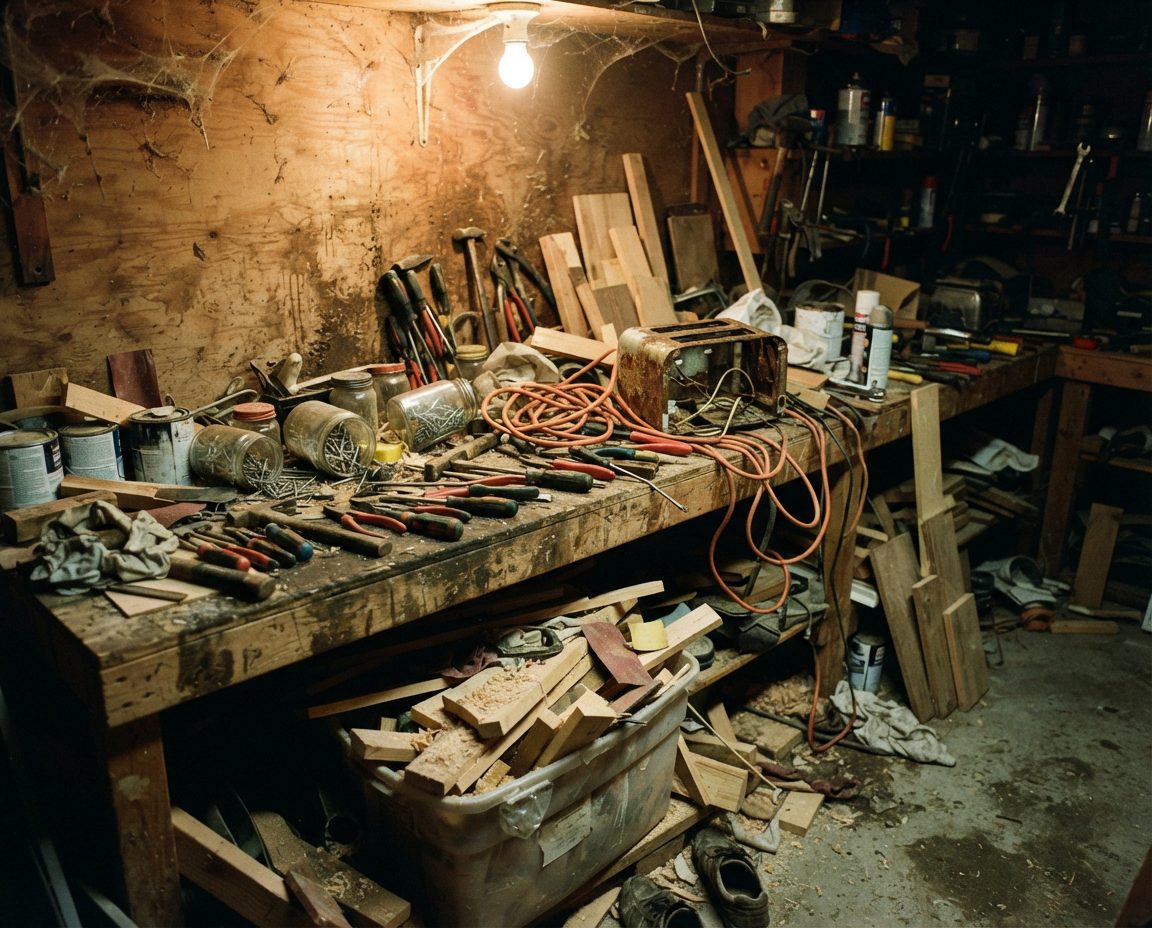
Illustration, not a client's garage.This is what a lifetime workbench tends to look like. The jars, paint tins and aerosol cans all go to different places, and the tool rack is often worth more than everything else in the room.
Firearms, Propane and Chemicals: Where We Stop
Three kinds of things change the job from hauling to a phone call. We look for them on the walk-through, before any loading starts.
Firearms and ammunition
We do not touch, move or transport firearms or ammunition. If one turns up, we stop work in that area and tell you. Don't put it in your car and drive it to a police station. Moving a firearm without the right licence and paperwork is itself a problem. The personal representative can call the Calgary Police Service non-emergency line, 403-266-1234, and ask how they want to handle a surrender. If the family wants to keep or sell it to a licensed owner, the RCMP Canadian Firearms Program, 1-800-731-4000, handles licensing and transfer questions.
Propane cylinders and fuel
Barbecue-size propane cylinders (under 30 lb) are free to drop off at the City of Calgary's household hazardous waste sites at fire stations. They must not be punctured or crushed, and vehicle propane tanks are not accepted at City Eco Centres or landfills, so ask a propane supplier about those. Sealed gas cans from the mower and snowblower go to the same drop-off.
Old chemicals
Parents who gardened or did their own car work leave shelves of products that can't go in a garbage load: pesticides, herbicides, solvents, pool chemicals, antifreeze. The fire-hall sites take up to 20 litres of household hazardous waste per visit, ideally in original containers. A full estate garage is often more than one visit, so we split it across trips rather than letting any of it ride in a mixed load. Check calgary.ca/hhw for current sites and hours before you go yourself.
If you're not sure what's in an unlabelled jar
Leave it closed and don't combine it with anything. Unknown liquids in old coffee tins and baby-food jars are common in estate garages. They go to the hazardous drop-off as they are, and the staff there decide.
From the First Walk-Through to Possession Day
Estate garages take longer than a regular cleanout because nothing leaves unseen. Our published estimate for an estate or downsizing garage is two to four days on site, quoted in phases so you can stop after any of them. The calendar around those days matters more than the days themselves:
Secure the garage
Before anything else, find every opener remote and the keypad code. Change the code if neighbours, trades or past caregivers knew it. An empty house with a full garage is a target.
Family walk-through
Family members tag what they want. Coloured painter's tape with a name on it works better than lists. Anything tagged is staged in one corner and never loaded.
Our walk-through and phased quote
We look for firearms, hazardous products, appliances and heavy items, then quote each phase separately so the estate isn't committed to the whole job up front.
Appraisal or sale window
If tools, collections or a vehicle might sell, leave room on the calendar for an appraiser, an estate sale or online listings before the cleanout. Once a load is weighed, it's gone.
Cleanout days
Sorting, set-aside boxes, donation runs, hazardous drop-offs and landfill trips, with your contact approving anything uncertain.
Empty slab, ready for photos
Swept, cobwebs down, and the floor cleaned if the listing needs it. Oil stains under where the car sat for twenty years are what buyers notice, and the slab is cheapest to clean while it's bare.
If a realtor has already set a listing or photography date, give us that date and we'll plan backwards from it. Possession dates in Calgary don't move to suit a garage.
Cash, Jewellery and Paperwork Found in Boxes
People of a certain generation kept things in the garage that most of us keep in a bank: envelopes of cash in a toolbox drawer, a watch in a tackle box, coins in a coffee can, a folder of share certificates on a shelf above the freezer. We open every box, drawer and container before it's sorted, and we handle what we find the same way every time:
- Anything that looks like money, jewellery or a valuable goes into a set-aside box on the spot, and you get a photo of it that day.
- The set-aside box goes to the personal representative, or to whoever they've named in writing. It doesn't go to the family member who happens to be on site.
- All paper is kept. Old tax returns, vehicle registrations, insurance policies, bank statements and letters all get boxed and handed over, even if they look like junk. Executors regularly go looking for records that turn out to have been in the garage.
- Photo albums, slides, film reels and home videos are kept together, whatever condition they're in.
If the Family Isn't in Calgary
If you live outside Calgary and flew in for the funeral with a few days to spare, you don't need to be on site for the cleanout. On the first call we agree on three things:
- How you approve uncertain items. Usually photos by text, answered when you can. Anything unanswered stays set aside rather than leaving.
- How we get in. A lockbox, a neighbour, or the listing realtor.
- Where set-aside items go. Held in the house, picked up by a named person, or shipped at the estate's cost.
If you're in Calgary for one weekend, use it for the family walk-through and tagging. That's the part that needs you in the room.
Working against a listing or possession date?
Call (587) 804-9266 with the date and the address and we'll tell you what's realistic before you commit to anything.
What Changes the Cost
Every estate garage gets quoted after a walk-through, because two double garages on the same street can differ by a week of work. These are the things that move the number:
- Sorting depth. Opening every container and approving uncertain items takes longer than loading. It's also why nothing valuable ends up at the landfill.
- Weight. The City of Calgary charges by the tonne ($113 per tonne for residential garbage in 2026, or a flat $25 for loads under 250 kg). Cast-iron vises, anvils, bags of concrete and old batteries add up fast.
- How much can be kept out of the landfill. Electronics, household hazardous waste, textiles and tires are free for residential drop-off. Scrap metal sells. Usable tools and furniture get donated.
- Appliances. Fridges, freezers and dehumidifiers carry a $17 refrigerant surcharge each at City sites, on top of weight.
- Hazardous volume. More than 20 litres means more than one drop-off trip.
- Access. A detached garage on a back lane with a narrow man-door takes longer to empty than an attached front-drive double.
One rule from the City's own landfill guidance shapes how we load: if a load mixes free and charged materials, or you only weigh in once, you pay the highest rate for everything in it. So free items never ride with garbage. Our general cleanout packages are on the garage cleanout Calgary page; for an estate we quote phase by phase after seeing the garage.
Calgary Details That Change the Job
Detached garages off the back lane
In Calgary's older neighbourhoods (Mount Royal, Elbow Park, Bowness, Bridgeland and much of the inner city) the garage often sits at the back of the lot on the lane, detached from the house, unheated, and sometimes older than the house beside it. These are the garages that collect mouse nests and water-damaged cardboard, and the ones where a parent kept the overflow nobody wanted inside. We check whether the truck can get down the lane and where it can stand before we book, because loading from the lane is far faster than carrying everything through the yard.
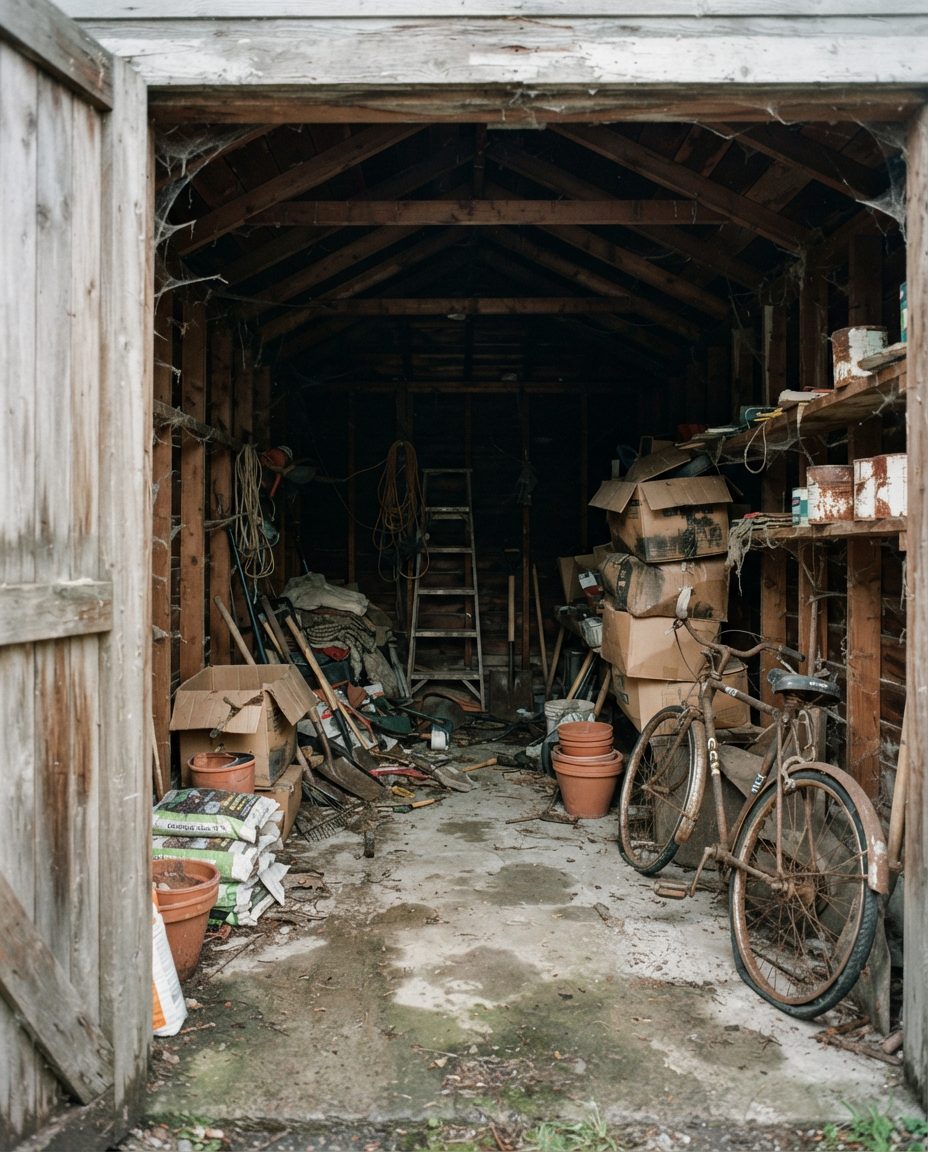
Illustration, not a client's garage.An unheated detached lane garage after years of storage. The pots and soil go to compost and donation, the bike to scrap or a bike charity, and the boxes get opened before anything else happens.
The chest freezer
If there's a second fridge or chest freezer in the garage, it's often still running and still full. Empty it before anything else, because a power-off freezer in a closed garage through a chinook warm spell is a far worse job a week later. A working unit can be donated; a dead one goes to a City site with the refrigerant surcharge.
Community Cleanups won't take the hard stuff
Families sometimes plan to wait for their community association's spring cleanup. These events take furniture, mattresses, cabinetry, carpets and old fence lumber, but not paint, propane, chemicals, car batteries, tires, electronics, metal, lawnmowers, barbecues or fridges. That's most of a garage. The City lists the 2026 events as finished, with the next schedule expected in spring 2027, which is too late for most estate timelines.
Bow Valley and acreage estates
Estates outside the city add their own problems: a shop building as well as the garage, fuel tanks, and in Canmore and the Bow Valley, garages that hold bird seed, pet food or garbage that has to come out before it draws in wildlife. We work across the Calgary area, including Cochrane, Airdrie, Okotoks and Chestermere.
After the garage is empty
If the house is going on the market, an empty slab with twenty years of oil and road salt on it still photographs badly. Garage floor cleaning takes the salt bloom and the worst of the stains off while the floor is bare, and a full garage clean covers walls, door tracks and windows. If a parent is downsizing rather than passing away, and wants to choose for themselves what moves, garage decluttering is the slower, decision-by-decision version of this service.