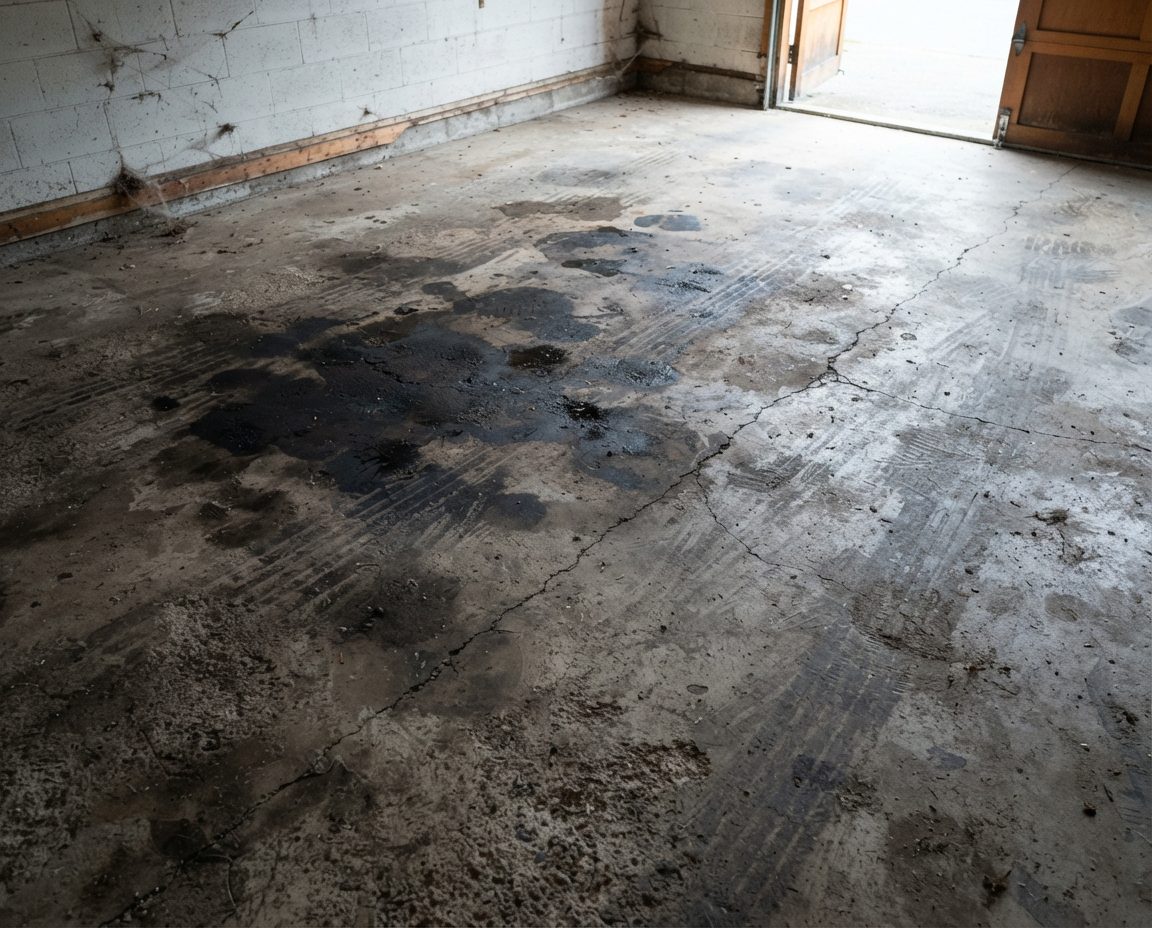
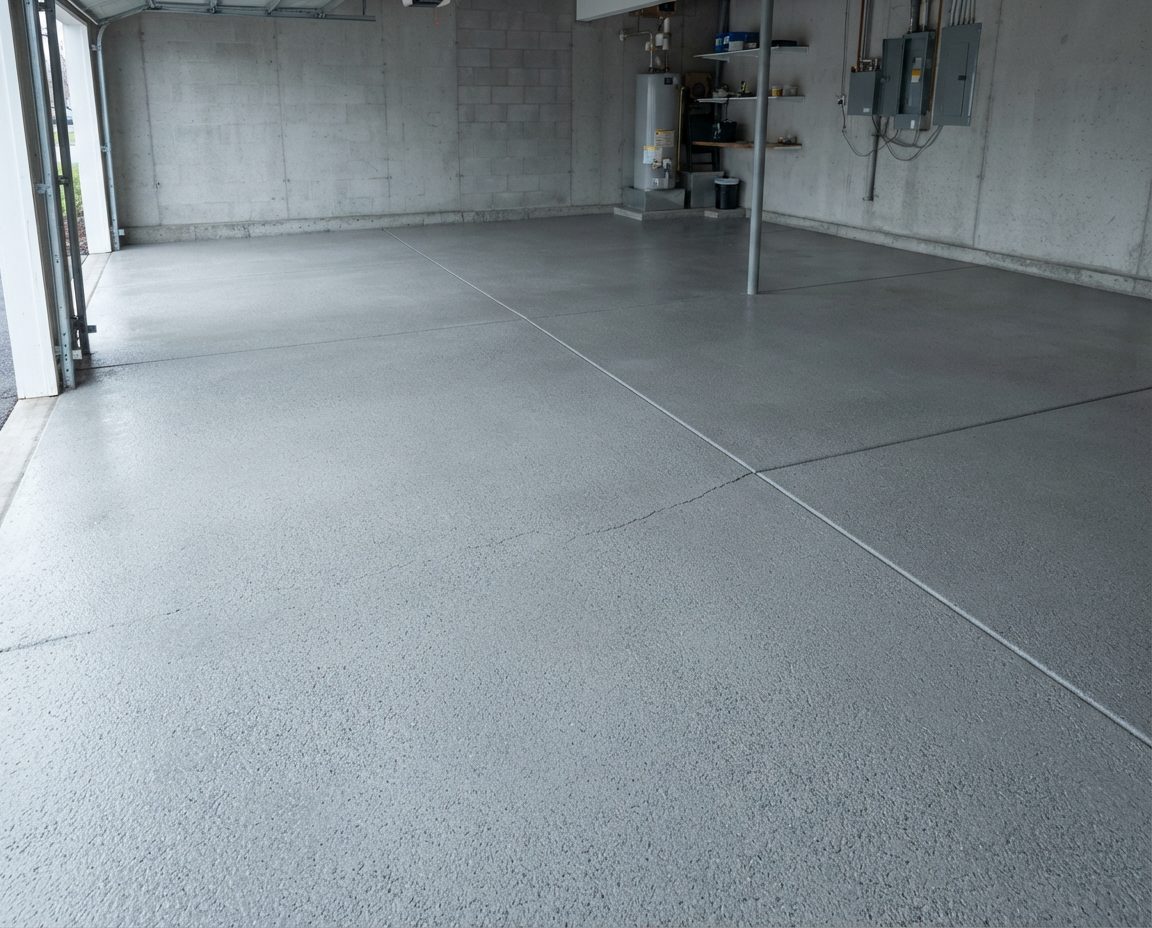
Set-in oil, drawn back out of the slabA pressure washer alone cleans the top surface and the stain wicks back within days. A poultice redissolves the oil and pulls it up out of the pore structure as it dries.
Every pressure washing company in Vancouver is chasing commercial parkade contracts. We do the thing they won't: residential garage floors. Hot-water pressure washing tuned to old coastal concrete, oil drawn back out of the slab instead of smeared across it, efflorescence removed, and a straight answer about where your moisture is coming from.
Set-in oil, drawn back out of the slabA pressure washer alone cleans the top surface and the stain wicks back within days. A poultice redissolves the oil and pulls it up out of the pore structure as it dries.
A garage floor is not an inert surface. It is a porous mineral matrix with a pore network running all the way through it, and in Vancouver that network is doing something almost every day of the year: moving water.
Groundwater sits high across much of this city. Much of Marpole, Sunset, Victoria-Fraserview and south Vancouver generally sits on Fraser delta deposits with a shallow water table. Richmond and Delta are essentially built on a floodplain. Add roughly 1,200 mm of annual rainfall and mild temperatures that keep the ground saturated from October through April, and you have slabs under sustained hydrostatic and vapour pressure from below for more than half the year.
Three consequences follow, and they're the reason a Vancouver garage floor needs a different approach:
Tape a 45 cm square of clear plastic sheet tightly to your garage floor on all four edges. Leave it 24 to 48 hours, then look underneath. Condensation on the underside of the plastic, or a dark patch of damp concrete beneath it, means your slab is actively passing moisture vapour. That is a rough field version of the ASTM plastic sheet test, and it is the single most useful thing a Vancouver homeowner can do before paying anyone to coat a garage floor.
| What's on the floor | Why it's there | How we treat it |
|---|---|---|
| Motor oil & transmission fluid | Drips from a parked vehicle, absorbed deep into porous concrete | Commercial degreaser with proper dwell time; poultice draw-out for set-in stains |
| White chalky efflorescence | Mineral salts carried up by groundwater moving through the slab | Mechanical agitation, then matched acid treatment with full neutralisation |
| Black or green mould & mildew | Sustained moisture at mild temperature — the Vancouver default | Substrate-appropriate antimicrobial treatment, then forced drying |
| Moss & algae at door line and apron | Coastal rainfall, shade, standing water at the threshold | Removal plus residual treatment so it doesn't re-establish in one wet season |
| Grey tyre rubber film | Plasticiser transfer from tyres, worse in warm weather | Alkaline cleaner and hot-water agitation; won't lift with cold water alone |
| Rust staining | Steel tools, jack stands, bike kickstands, rebar too close to the surface | Oxalic-based rust remover; rebar-source staining is flagged, not just cleaned |
| Winter road grit & brine | Tracked back from Sea-to-Sky, the Coquihalla and the North Shore mountains | Flush and neutralise — chloride left on concrete accelerates deterioration |
| Paint, adhesive, drywall compound | Left over from renovation work staged in the garage | Mechanical removal; solvent only where the slab tolerates it |
This is the most common disappointment homeowners have with garage floor cleaning, and it's worth explaining properly because it determines whether you get a result or waste a Saturday.
When oil lands on porous concrete it doesn't sit on top. Capillary action draws it down into the pore network, sometimes several millimetres deep. A pressure washer — even a good one — cleans the top surface. It looks fixed. Then over the following days the remaining oil wicks back upward and the stain reappears, often looking worse because the surrounding concrete is now clean.
The method that actually works is a poultice. An absorbent carrier is mixed with a solvent into a paste, spread over the stain, and covered. The solvent redissolves the oil; then as the poultice dries, capillary action reverses and pulls the dissolved oil up into the absorbent material, which is then scraped off and disposed of. It takes hours rather than minutes, and it is the difference between a stain that lightens and a stain that leaves.
Honest limits: oil older than roughly a decade on a very porous or already-spalling slab may lighten by 70 to 90 percent rather than disappear entirely. Some stains need two poultice cycles. We'll tell you which of those you're looking at when we quote, not after you've paid.
Vancouver homeowners confuse these constantly, and the confusion costs money in both directions: people panic about harmless salt deposits, and people ignore genuine mould because they've decided it's "just that white concrete stuff."
| Test | Efflorescence | Mould |
|---|---|---|
| Spray it with water | Dissolves and disappears | Stays put, may smear |
| Colour | White or greyish-white only | White, black, green, grey, pink or orange |
| Texture | Crystalline, gritty, powdery | Fuzzy, filamentous, sometimes slimy |
| Smell | None | Musty, earthy |
| Where it appears | Concrete and masonry only | Concrete, drywall, wood, cardboard, fabric |
| Health risk | Effectively none | Respiratory irritation; worsens asthma |
| What it tells you | Water is moving through your slab | You have sustained moisture and organic material |
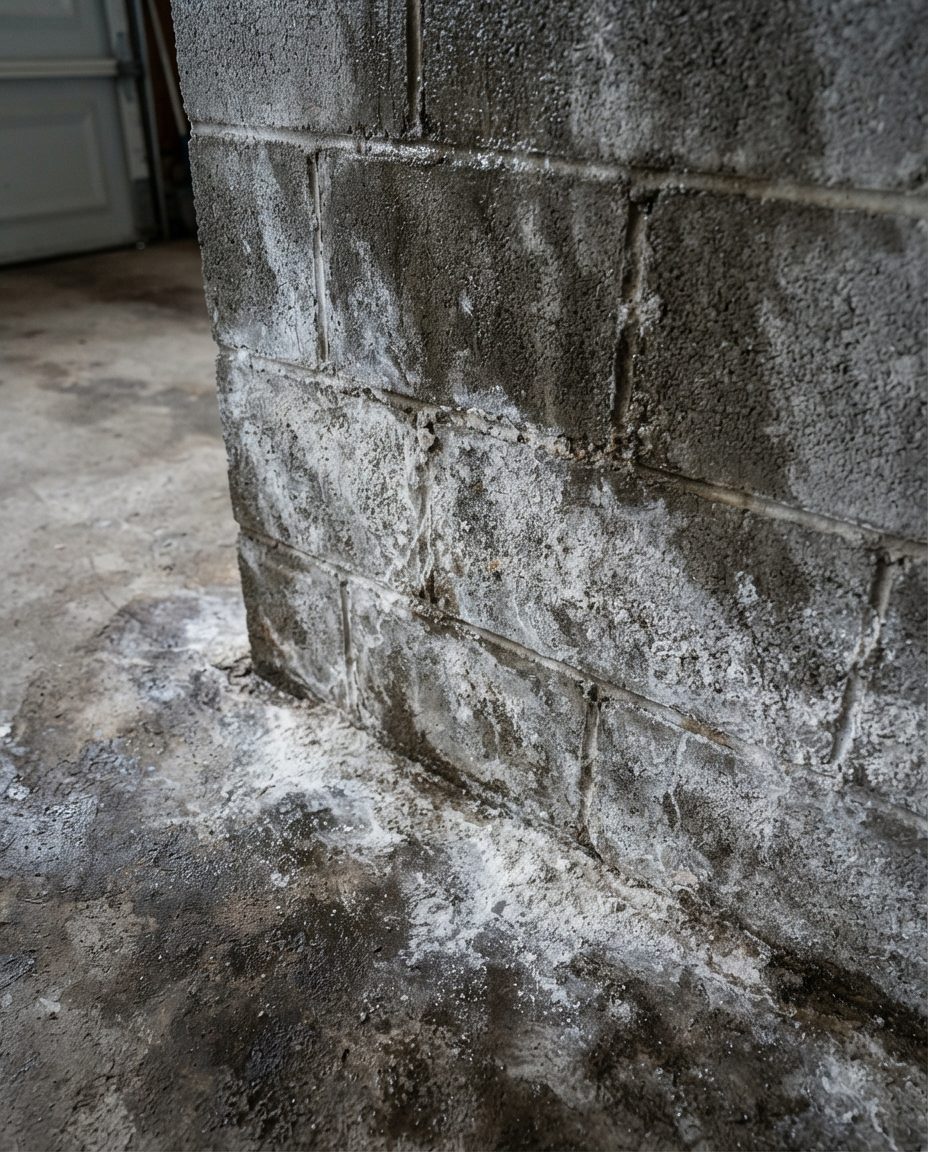
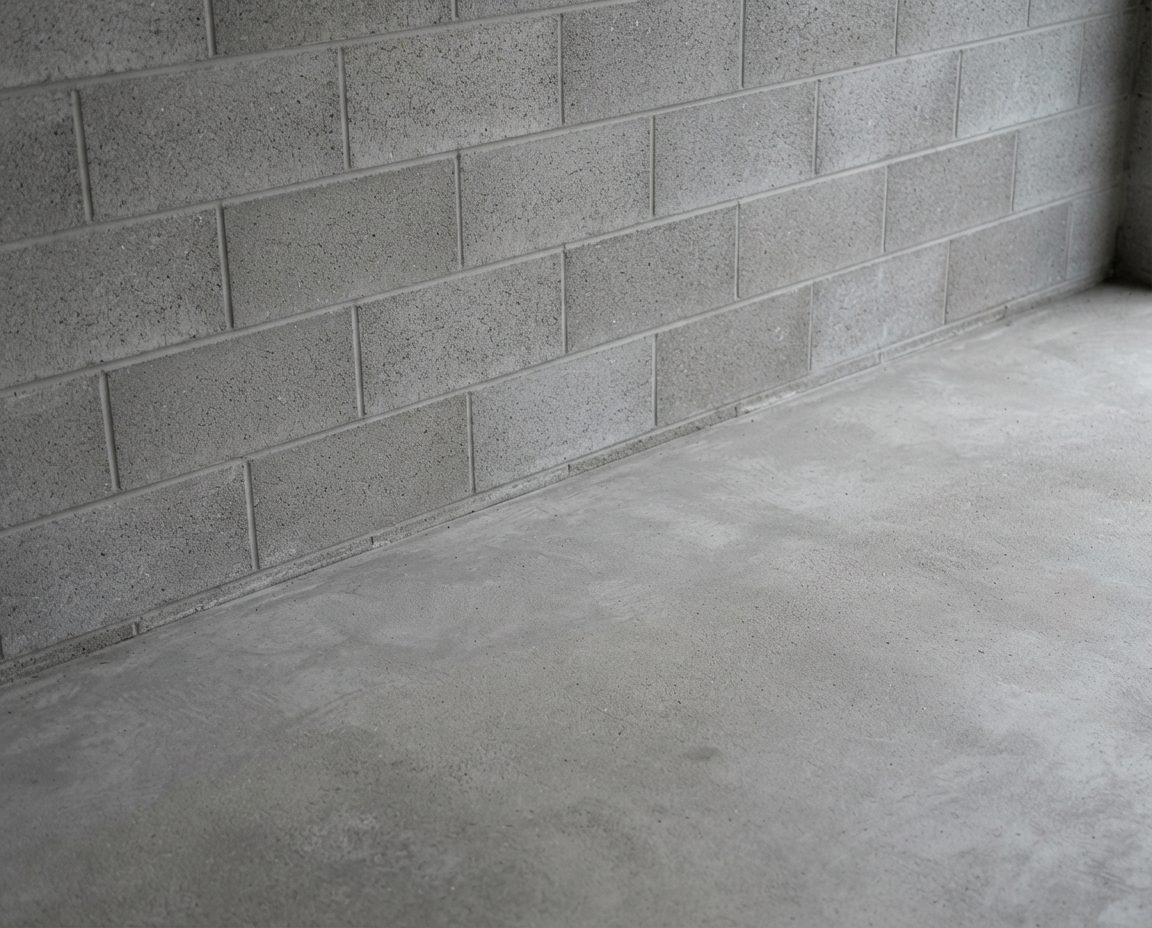
Efflorescence: the harmless one that warns youRemoved mechanically and with a matched acid treatment, then fully neutralised — acid residue left on concrete keeps working on it long after we've gone.
Note the last row, because it's the point: both are symptoms of the same underlying problem. Efflorescence is the harmless one, but it is a reliable early warning that the conditions producing mould are already present. Vancouver homeowners who treat efflorescence as a cosmetic annoyance usually meet the mould version twelve to eighteen months later.
Almost nobody asks this, and in Vancouver it genuinely matters.
Storm drains in Metro Vancouver are not connected to sewage treatment. Water entering a catch basin in your lane discharges, largely untreated, into local creeks, the Fraser River and Burrard Inlet. Several of those creeks are salmon-bearing and are the subject of active restoration work. Municipalities across the region restrict discharge of wash water containing oil, grease, solvents and detergent into the storm system, and enforcement in Vancouver has tightened.
Practically, this means we contain and extract wash water from any floor with meaningful oil or chemical contamination rather than flushing it down the lane. On clean-water rinsing of an uncontaminated slab, controlled discharge is fine. The distinction matters. If a contractor is hosing degreaser and motor oil straight out of your garage and into the nearest catch basin, that's a liability attached to your address and a genuinely bad outcome at the other end of the pipe.
Epoxy and polyaspartic garage floor coatings are heavily marketed in Vancouver, and a good one genuinely transforms a garage. Metro Vancouver pricing generally runs $6–$11 per square foot for flake epoxy systems and $9–$16 for polyaspartic, putting a typical double garage somewhere between roughly $2,800 and $7,200 installed.
Here's the part the sales visit tends to skim: coating failure in Vancouver is overwhelmingly a moisture problem, not a product problem. Vapour rising through an uncontrolled slab pushes at the underside of the coating film. Given a wet Vancouver winter, that pressure produces blistering, bubbling and delamination — and it does it regardless of how good the coating was.
The correct sequence is:
We do steps one through three. We don't sell coatings, which is exactly why we'll tell you if your slab isn't ready for one — there's nothing in it for us either way.
We check slab age, porosity, spalling, existing coatings and crack pattern, then test pressure and nozzle on an inconspicuous corner. This determines whether your floor gets high-pressure hot water or low-pressure chemical cleaning with extraction — a decision made on your concrete, not from a price list.
Floor cleared completely, contents moved out or lifted onto racking, then swept and vacuumed. Loose grit left on the slab acts as abrasive under pressure and scars the surface.
Each contaminant gets its own chemistry and its own dwell time: degreaser on oil, oxalic on rust, alkaline on tyre film, antimicrobial on mould, matched acid on efflorescence. Set-in oil gets a poultice applied at this stage so it can draw while we work elsewhere.
Heat does most of the work on grease. A rotating surface cleaner gives even coverage without the wand striping you get from freehand jetting, and keeps pressure distributed rather than concentrated on one line of old concrete.
Wash water is extracted rather than flushed to the lane wherever there's oil or chemical load. Any acid treatment is fully neutralised — acid residue left on concrete keeps working on it long after we've gone.
Air movers until the slab is genuinely dry, not just surface-dry — closing a damp garage in Vancouver creates the exact problem you paid to remove. You get a written note on slab condition, moisture entry points, and whether the floor is a candidate for sealing or coating.
Starting prices for residential garage floors across Metro Vancouver. Final quote given on site, before work begins.
We'd genuinely rather you knew which side of this line you're on before calling. For a lightly soiled slab with no oil and no efflorescence, a rented pressure washer and a Saturday is a perfectly sensible choice.
| Factor | DIY weekend | Professional service |
|---|---|---|
| Cost | $90–$150 washer rental plus $60–$100 in chemicals | $249–$549 typical |
| Light dirt and dust | Works well | Overkill |
| Fresh oil drips | Works if treated quickly | Not necessary yet |
| Oil older than a year | Surface only — stain returns within days | Poultice extraction actually removes it |
| Efflorescence | Usually misidentified; acid misuse damages slabs | Correct acid, correct dilution, full neutralisation |
| Mould treatment | Bleach on porous concrete is largely ineffective | Substrate-matched antimicrobial plus forced drying |
| Old or spalling concrete | High risk of stripping surface paste permanently | Pressure tested and tuned to the slab |
| Wash water handling | Typically flushed to the storm drain | Contained and extracted where contaminated |
| Drying in wet season | Slab stays damp; mould risk rises | Air movers, forced dry-down |
| Time cost | 6–10 hours plus rental pickup and return | You're not there for it |
The honest summary: DIY handles dirt. It does not reliably handle oil, efflorescence, mould, or fragile old concrete — which between them describe most Vancouver garage floors that people actually get around to calling about.
All 22 Vancouver neighbourhoods and across Metro Vancouver:
City of Vancouver neighbourhoods
Metro Vancouver — tap a city for local detail
A single-car garage floor starts at $249 and a standard double at $329. Heavy oil staining needing poultice extraction, or significant efflorescence, typically adds $80 to $200. Most Vancouver residential garage floors come in between $249 and $549. We price on the slab, not the postcode.
Usually — but not with a pressure washer alone. Oil that's sat on porous concrete for years has migrated into the pore structure; blasting the surface cleans the top layer and the stain wicks back within days. We use a poultice that redissolves the oil and draws it back up out of the concrete as it dries. Stains older than about ten years on very porous slabs may lighten dramatically rather than vanish, and we'll tell you that when we quote.
It can, if someone runs maximum pressure on concrete that can't take it. Many Vancouver garages sit on 1920s–1960s slabs that are softer and more porous than modern concrete, often already spalling. We test a corner first and tune pressure and nozzle accordingly. On badly deteriorated slabs we drop high pressure entirely in favour of low-pressure chemical cleaning with wet extraction.
Metro Vancouver storm drains discharge largely untreated into creeks, the Fraser and Burrard Inlet, and municipalities restrict discharge of oily or detergent-laden wash water into them. We contain and extract wash water from contaminated floors rather than flushing it to the lane. A contractor hosing motor oil into your nearest catch basin is creating a problem attached to your address.
Yes — and more importantly, moisture-test it before committing to a coating at all. Coating failure in Vancouver is overwhelmingly a moisture problem, not a product problem: vapour rising through the slab pushes at the underside of the film until it blisters or delaminates. A clean and a moisture assessment before you spend $3,000–$7,000 tells you whether you need a mitigating primer first. We don't sell coatings, so we've no reason to tell you anything but the truth about it.
That's efflorescence — mineral salts carried up by water moving through the slab. Light deposits come off with stiff-brush agitation and a purpose-made remover. Heavier build-up needs diluted acid matched to the concrete's age, followed by full neutralisation. But removal is only half the job: it returns unless the water movement causing it is addressed, so we identify the source too.
A single-car floor is 2–3 hours of work, a double 3–4. Drying is the Vancouver variable. In dry summer weather it's walkable within an hour and parkable in 3–4. Through the wet season we bring air movers, which puts you at roughly 4–6 hours. We never close a wet garage door on a damp slab.
We clean individual assigned stalls, townhouse tandem garage floors and private strata garages. Whole-building common-property parkade scrubbing is a commercial contract run on ride-on scrubbers with traffic management and council approval — we refer that out rather than pretending to do it.
Once a year suits most homes, best in late spring after the wet season ends. Floors taking a daily driver through winter, or showing recurring efflorescence, do better twice a year. The autumn clean is the one that pays off — entering the wet season with a clean, degreased slab prevents the problem rather than repairing it.
Free on-site quote and slab assessment. Fixed price before we start. Written report on slab condition and moisture entry points.
Serving Vancouver, Burnaby, Richmond, North & West Vancouver, New Westminster, Coquitlam, Surrey and Delta.