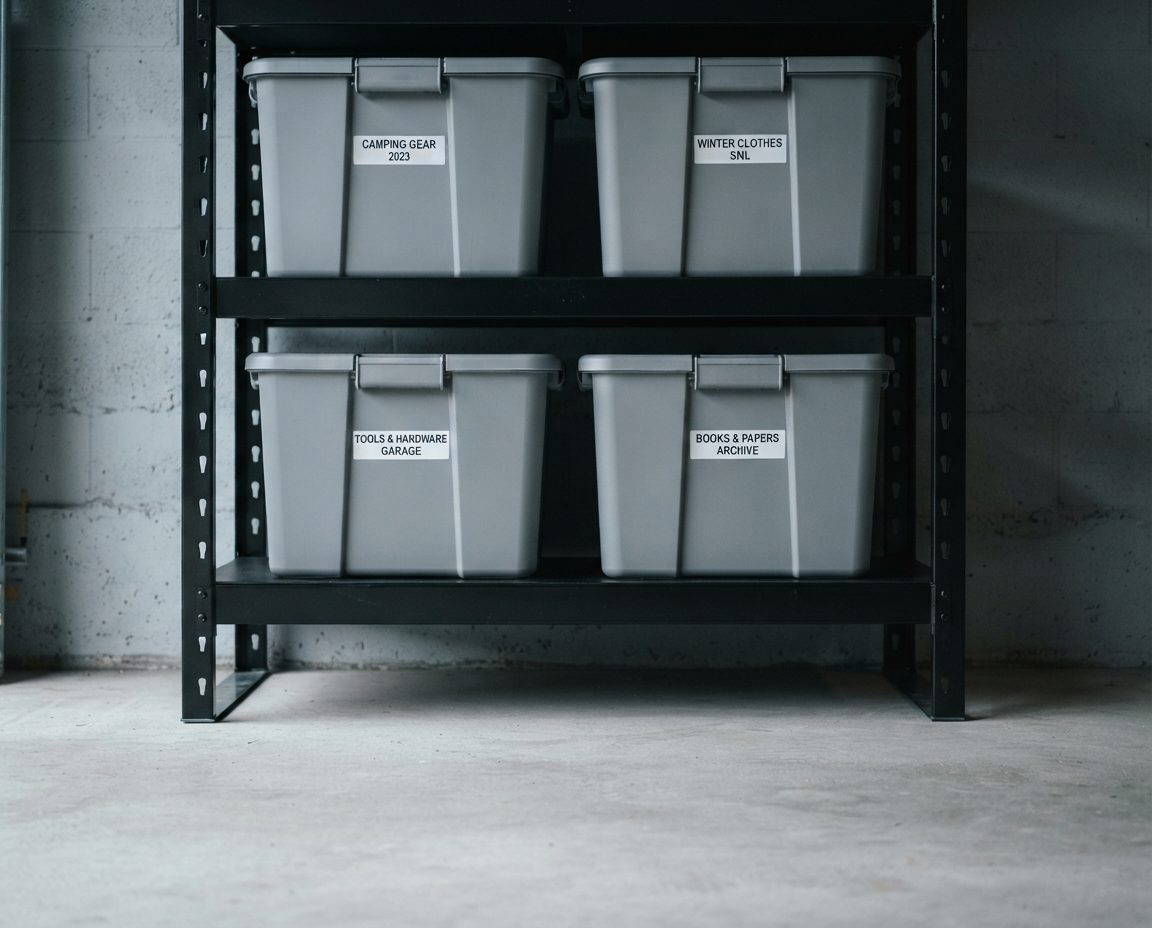
The garage is where most households keep their heaviest, sharpest and most flammable things, usually stacked high on shelving held up by nothing but its own weight. We reorganize Metro Vancouver garages so a strong shake has less to throw: shelving fixed to the studs, heavy things on the bottom, paint and fuel behind latched doors, the gas valve and panel left reachable, and a dry, sealed shelf for the emergency kit by the door you would actually use to get out.
PreparedBC, the provincial preparedness program, says about 4,000 earthquakes are recorded in British Columbia every year. Almost all are too small to feel. The west coast carries the highest risk in the province, and the scenario planners worry about most is a magnitude 9.0 megathrust earthquake on the fault off Vancouver Island.
The province's disaster and climate risk assessment, dated October 2025 and reported by The Canadian Press that December, modelled that event on a summer day. It put the chance of a quake that large at 2 to 10 per cent over the next 30 years, and placed the heaviest damage on Vancouver Island and a band roughly 20 kilometres wide along the mainland coast, Vancouver included, from the U.S. border to the Sunshine Coast. The modelled toll was more than 3,400 deaths and more than 10,000 injuries on the first day, and $128 billion in costs. The report itself says those figures carry wide uncertainty.
None of that tells you when. It does tell you what to plan for, and PreparedBC's own guide makes the point that matters for a garage: most earthquake injuries happen when people are knocked over or hit by things that fall. The building may ride out the shaking. The steel shelf of paint cans beside the door is a separate question, and it is the one we can fix in a day.
Walk through almost any Metro Vancouver garage and count the things above waist height that weigh more than a few kilograms. Paint cans on the top shelf. A toolbox on a wire rack. Tiles left over from the bathroom renovation. Stacked cardboard boxes leaning on each other. A freestanding steel unit that has never been screwed to anything, loaded heaviest at the top because that is where the space was.
Inside the house, people have spent years learning to strap bookcases. The garage rarely gets the same attention, even though it often holds the water heater, the gas meter or its shutoff, the electrical panel, the car, and every flammable liquid the household owns. It is also a way out: for many lane houses and townhouses, the garage door or the man door is the quickest route to open ground.
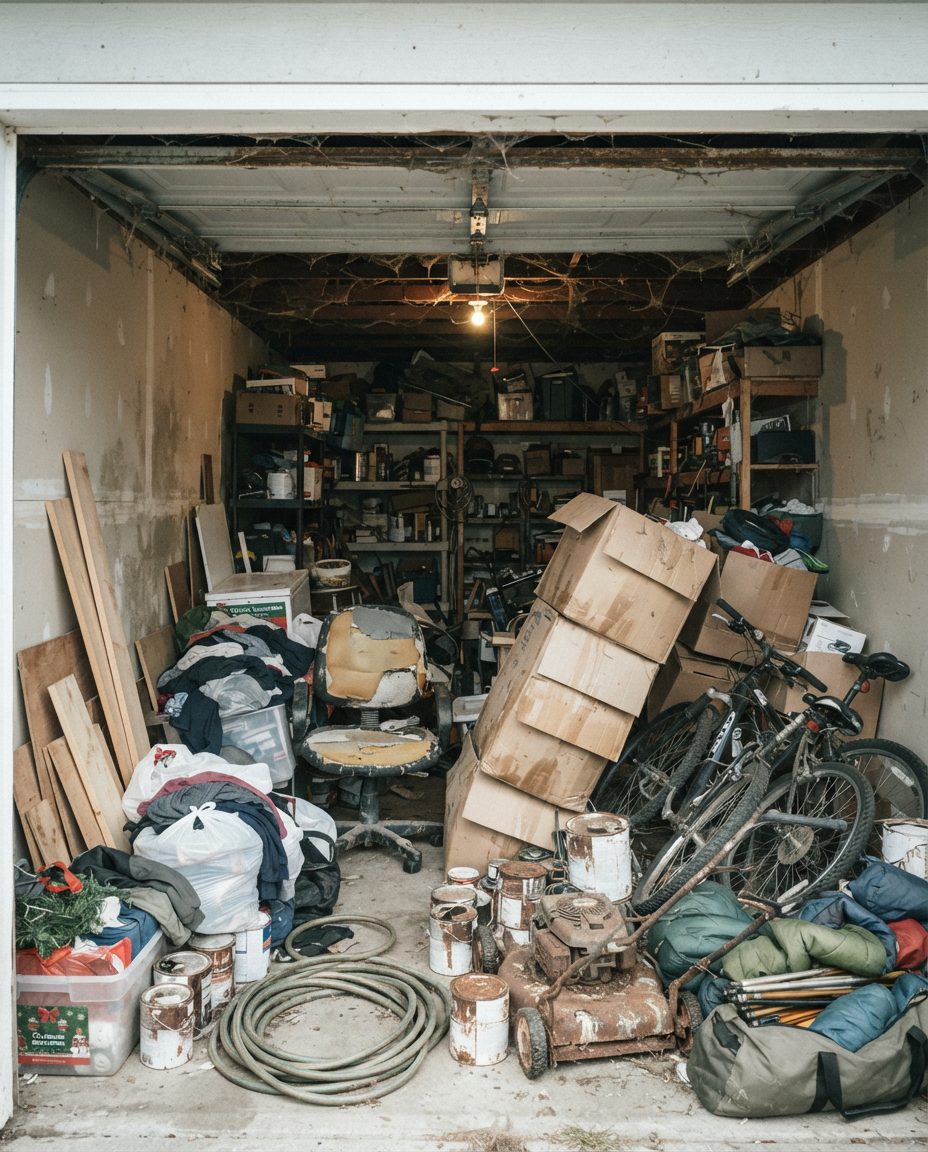
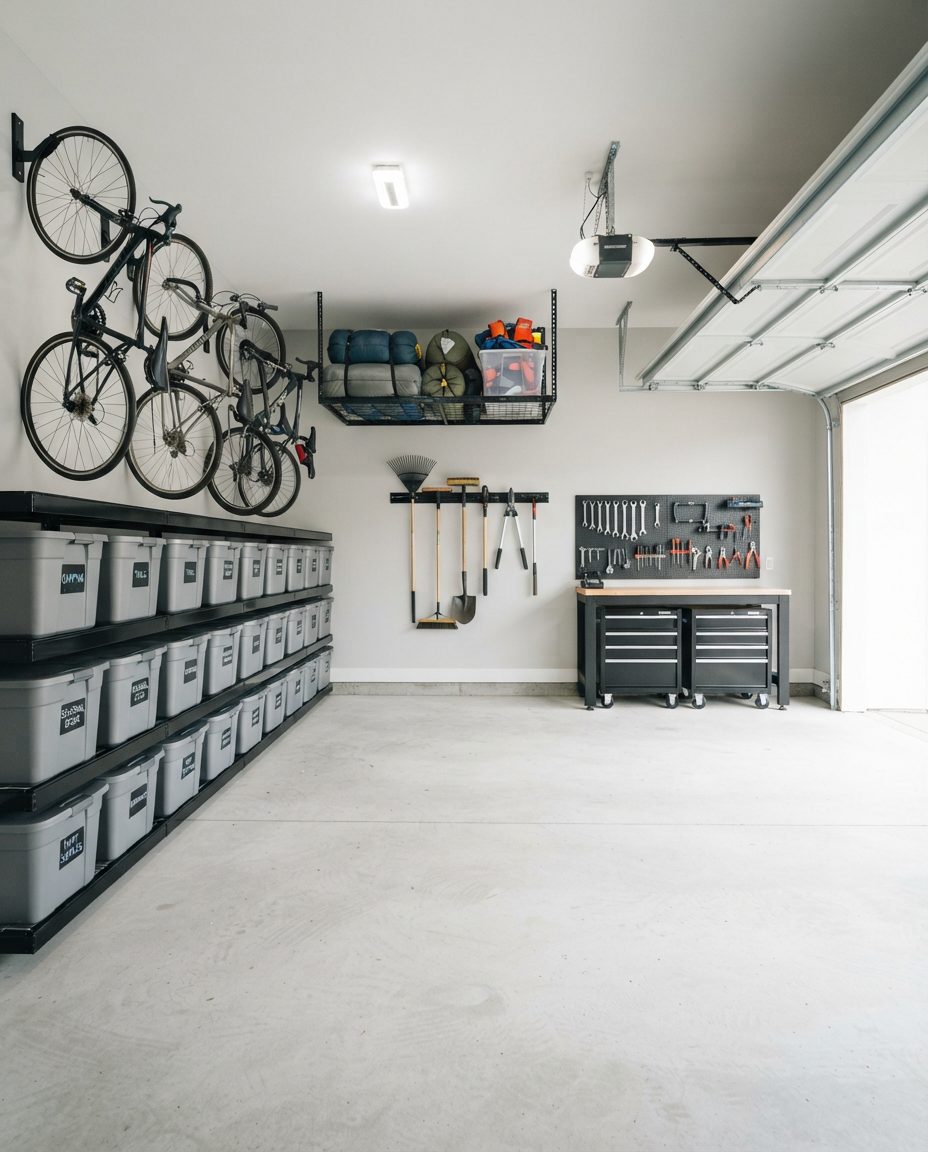
Fewer things to fall, a clear floor to move acrossAn example layout. Boxes stacked head-high are the first thing to come down in a shake; here everything sits in lidded bins on low, continuous shelving, the overhead rack holds only sleeping bags and light camping gear, and the path to the door has nothing in it.
PreparedBC's earthquake guide asks households to anchor bookcases, cabinets and shelving to wall studs with L brackets or corner brackets. The Federal Alliance for Safe Homes adds the detail that decides whether it works: the screws have to reach the studs, because screws held only by drywall or plaster pull straight out. In a garage that is an easier job than in a living room, since you do not care about a bracket showing.
Every shelving unit we install or keep gets fixed to framing at the top. Where units sit side by side, we tie them to each other as well as to the wall, so a row of shelving moves as one piece. Many older Vancouver houses have a concrete foundation wall along one side of the garage instead of a framed one; there we use masonry anchors rather than wood screws.
Heavy items go on the lowest shelf, which is the standard advice from every preparedness agency and the one most garages ignore. In practice that means the toolbox, the spare tiles, bags of salt or fertilizer and anything in glass sit at knee height or on the floor level of the unit. Middle shelves take the bins you open every week. The top shelf takes light, soft, rarely used things: holiday decorations, spare bedding, empty coolers.
Open cardboard boxes spill everything when they fall, and in this climate they have usually gone soft from the damp before a quake ever arrives. We move contents into hard plastic bins with clip-down lids. A bin that slides off a shelf usually stays shut, and a shelf lip or a simple bar across the front of each level stops most bins from walking off at all.
Ceiling racks are one of the best ways to free floor space in a narrow Vancouver garage, and they are also the storage most likely to drop something on a person or a windshield. We only hang them from ceiling joists, never from drywall alone, and we set a firm rule for what goes up there: sleeping bags, tents, holiday decorations, pool floats, off-season clothing in sealed bins. Nothing heavy, nothing glass, no paint, no tools.
We also look at where the rack sits. Over the hood of the car is fine for soft goods. Directly over the spot where you stand at the workbench, or over the door from the house, is not.
The worst thing a garage shelf can drop is a mixture. Half-used paint, solvents, bleach, pool chemicals, fertilizer and gas cans tend to collect on the same open shelf, often a high one, often beside the water heater or the furnace.
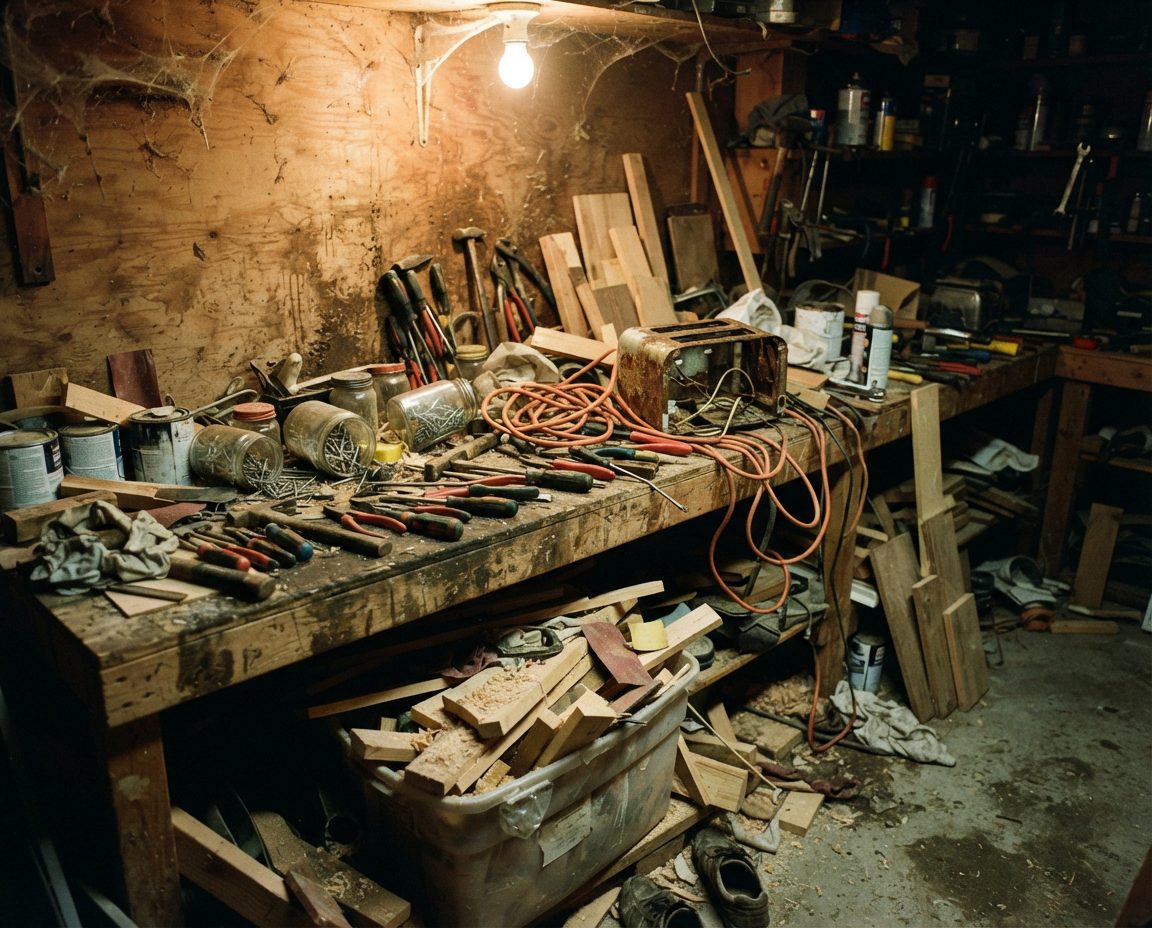
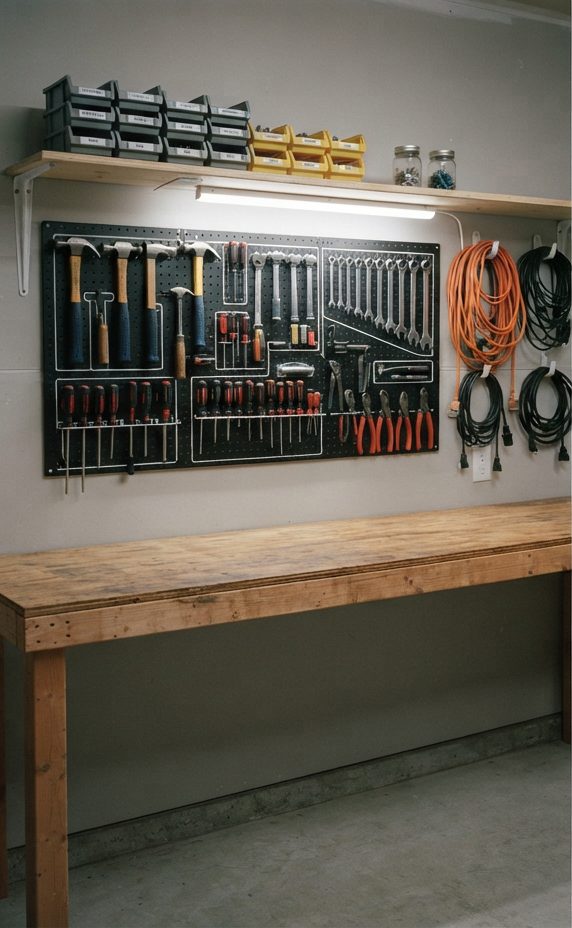
Nothing loose, nothing in glass up highAn example workbench reset. Jars of screws and open tins on a bench are exactly what breaks and spreads in a shake. Hardware moves into plastic drawers, tools hang in fixed spots, and liquids leave the bench for a latched cabinet low down.
Our layout puts all of it in one closed, latched cabinet on the floor or the lowest level, fixed to the wall. PreparedBC recommends push or pull latches on cabinet doors so they cannot swing open in shaking; the same latch that keeps dishes in a kitchen cabinet keeps a can of thinner off a garage floor. Inside, we separate the groups that should never meet if containers break: bleach and other chlorine products on one side, ammonia-based cleaners on the other, pool chemicals in their own sealed tub, and fuel cans in a separate spot away from anything with a pilot light or a hot surface.
Most garages also carry years of paint and chemicals nobody will use again. We sort that out during the job and take it to a proper return depot, which is cheaper and safer than building a bigger cabinet. Our garage decluttering in Vancouver page explains how that sort works.
In many Metro Vancouver houses the hot water tank lives in the garage. PreparedBC asks households to anchor it snugly to the wall with straps, and the Federal Alliance for Safe Homes describes heavy-gauge metal strapping at the top and bottom, fastened into studs. A tank that walks or tips can tear its own gas and water connections. PreparedBC also suggests a licensed gas contractor fit a flexible gas line where one is needed.
Strapping a water heater and changing a gas line are jobs for a licensed plumber or gas fitter, and we do not do them. What we do is make sure your storage never gets in their way, or in yours. Every plan we draw marks three things that have to stay reachable with nothing stacked in front of them: the gas shutoff, the main water valve and the electrical panel. PreparedBC recommends keeping a wrench by the gas valve, and only shutting the gas off if officials tell you to or you smell gas. If it does get shut off at the meter, the guide is clear that only a licensed gas contractor should turn it back on. We hang a wrench on a hook beside the valve and label it.
A 1 metre strip of floor and wall in front of the water heater, the gas valve and the panel stays empty on every plan. No bins parked there "for now", no bikes leaning on the tank, no shelving built across the panel door. In a lot of the garages we see, the panel is behind a wall of boxes; reaching it should take seconds, not a cleanout.
PreparedBC's earthquake guide asks every household to store at least two weeks of supplies for each person and pet, kept together in one accessible place. Water is the bulky part: four litres per person per day, for drinking and sanitation. For a family of four that is 224 litres of water before you add food, a manual can opener, a first-aid kit and medications, dust masks, garbage bags, a flashlight and radio with spare batteries or a hand crank, a phone power bank, warm clothes, sturdy shoes, cash in small bills and copies of important documents.
Very few houses have a closet that holds all of that, so it ends up in the garage, and a Vancouver garage is hard on stored supplies. Cardboard flats of water go soft on a damp slab, batteries corrode, and the whole kit slowly disappears behind newer boxes.
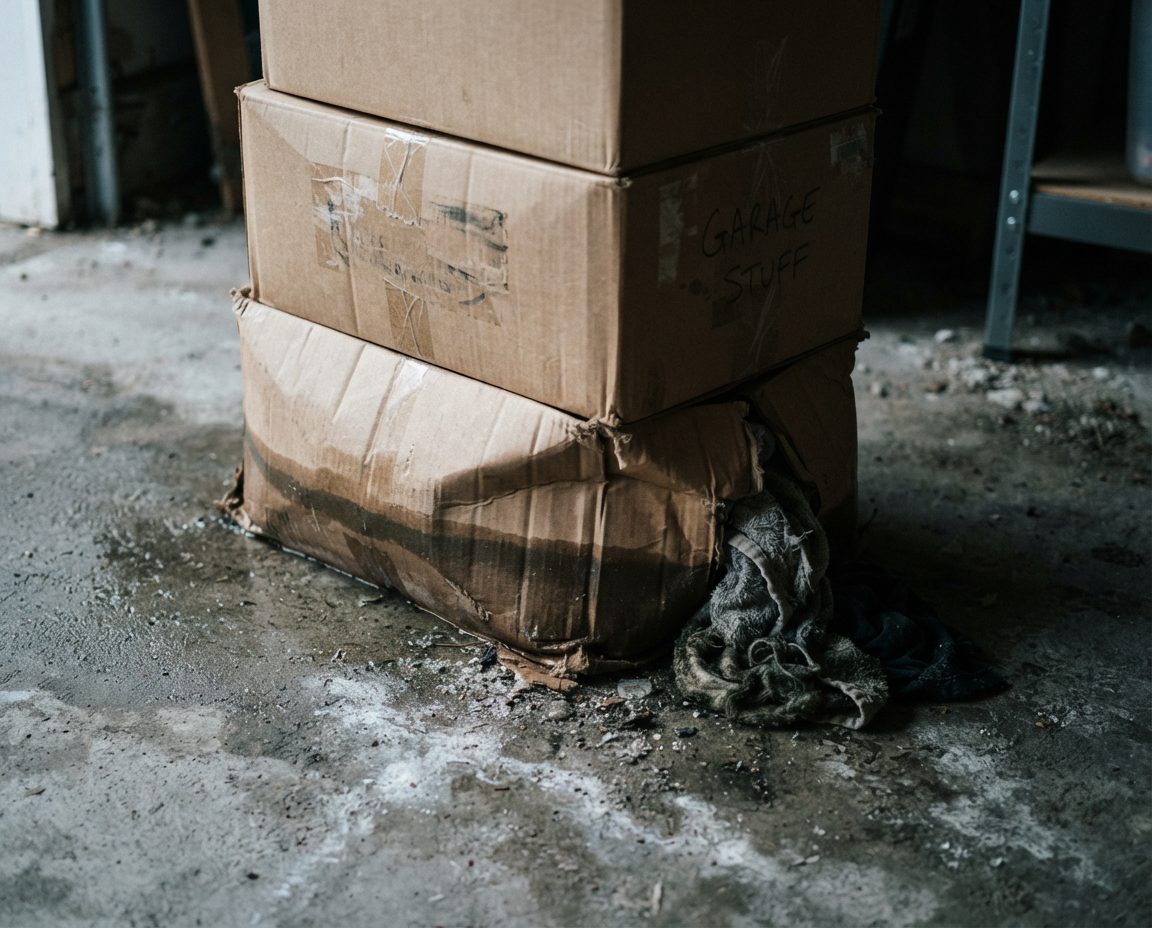
We give the kit its own labelled zone. Water stays off the slab on the lowest shelf of an anchored unit, because 20 litre containers are the last thing you want on a high shelf. Food, first aid, lights and documents go into gasketed bins with clip lids, labelled on two sides so they can be read from the door. Nothing heavy is stored above the kit. If you keep a rotation date on the water and food, we put it on the bin label where you will see it at the spring clean. Grab-and-go bags, which PreparedBC asks for one per person, are better kept inside the house or in the car; the garage holds the deeper supply. Damp is the enemy of all of this, and our guide to mould in Vancouver garages covers keeping a slab and the walls dry enough to store on.
PreparedBC's advice during shaking is Drop, Cover and Hold On: get down, cover your head and neck, hold on to something sturdy until it stops, then count to 60 before you get up. After that you may need to leave, and the garage is often the route.
Three things decide whether that route works. The path from the house door to the man door or the big door has to be clear of anything tall enough to fall across it, so we keep shelving off that line. The garage door opener needs power, so everyone in the house should know where the red manual release cord is and be able to reach it without a ladder or climbing over bins. And the car should not be the thing blocking the side door, which in a tight tandem means setting the shelving depth so the door still opens with a car parked.
The Great British Columbia ShakeOut drill runs every October; in 2026 it is October 15. It is a good day to walk the route out of your own garage with the lights off and see what is in the way.
The older detached garages behind Vancouver houses are often unlined, with exposed studs and a bare concrete or block wall on one side. Anchoring is easy into open studs and slower into block. These garages tend to collect the heaviest leftovers from decades of house projects, so a lot of the earthquake work here is removal. If the garage is coming down for a laneway home, our laneway garage clearing service is the better starting point.
Townhouse garages in Burnaby, Richmond and the Tri-Cities are long, narrow and usually share walls that the strata owns. Check your bylaws before anyone drills, because some restrict fastening to common property. PreparedBC's guide for apartments, condos and townhomes suggests raising emergency planning with your strata council or at the AGM, including shared storage for supplies like water and blankets. Where wall anchoring is not allowed we build lower, wider, freestanding storage with a low centre of gravity. Our Burnaby garage organization page covers tandem layouts in more detail.
In Surrey, Coquitlam and the newer parts of the North Shore, the garage is usually a drywalled double with plenty of wall. These are the simplest to make safe and the easiest to overload, because there is room for tall shelving on three walls. Our North Vancouver garage organization work includes a dedicated earthquake kit shelf as standard.
It starts with a free on-site assessment. We walk the garage with you, find the studs and joists, note what sits above waist height, locate the water heater, gas shutoff, water valve and panel, and check the routes to each door. You get a written plan and a fixed price before anything is bought.
On the day, we empty the garage, sort and remove what is leaving, clean the floor, then install or re-fix the shelving into framing, load it heavy-to-light from the bottom up, set up the latched chemical cabinet and the kit zone, and label everything. Most single and tandem jobs take a day. If you want new shelving or racks rather than re-anchoring what you have, our garage storage solutions page compares the options, and the same zone method runs through all of our garage organization in Vancouver.
Service pricing below. Stud and joist anchoring of the storage we install or keep is included. Shelving, bins, cabinets and racks are quoted separately at cost.
We work across Metro Vancouver: Vancouver, Burnaby, Richmond, Surrey, Coquitlam, New Westminster, North Vancouver and West Vancouver. If bikes are what fills your floor, our garage bike storage guide covers wall rails and a safe e-bike charging spot, which belongs away from the exit for the same reasons as everything on this page. GarageScape started in Alberta, where the garage storage we build in Calgary deals with frost and road salt instead of shaking. Start from the GarageScape home page to see everything we do.
Safer, yes. Fix every shelving unit to wall studs or, on a concrete wall, with masonry anchors, tie neighbouring units together, put the heaviest items on the lowest shelf and store contents in lidded bins. PreparedBC asks households to anchor shelving to studs with L brackets or corner brackets, and screws that only grip drywall will pull out.
Anything heavy, anything in glass, paint, solvents, pool chemicals, fuel and tools. High shelves and overhead racks should hold light, soft, rarely used things such as holiday decorations, sleeping bags, spare bedding and empty coolers.
Yes, if it is kept dry and reachable. Put water on the lowest shelf of an anchored unit and off the slab, put food, first aid, lights and documents in gasketed bins with clip lids, and store nothing heavy above it. Keep grab-and-go bags in the house or car, since the garage holds the deeper supply.
PreparedBC recommends four litres per person per day, for drinking and sanitation, for at least two weeks. For a household of four that is 224 litres, which is why most families end up storing it in the garage.
No. Those are jobs for a licensed plumber or gas fitter. We keep a clear zone in front of the water heater, gas shutoff, main water valve and electrical panel, hang a labelled wrench by the gas valve, and make sure no storage blocks any of them.
Check your strata bylaws first, because some restrict fastening to walls that are common property. If anchoring is not allowed, we build lower, wider freestanding storage with heavy items at the bottom so it is much harder to tip.
Organization starts at $549 for a single or tandem garage, $899 for a standard double, and $1,800 for a full transformation that bundles decluttering, a deep clean and the organization build. Anchoring the storage we install or keep is included; shelving, bins and cabinets are quoted separately at cost.
Free on-site assessment. We find what can fall, plan where it should live instead, and give you a written plan and fixed price before we start.
Serving Vancouver, Burnaby, Richmond, Surrey, Coquitlam, New Westminster, North Vancouver and West Vancouver.